
Interference of Two Same-Frequency Waves: Effect of Phase Difference on Superpos
Loading the math board and drawing, please wait…
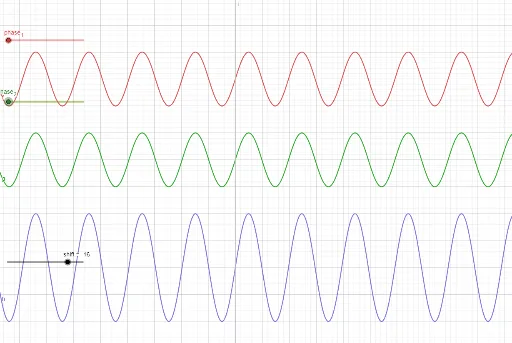
This GeoGebra example demonstrates the interference of two sinusoidal waves with identical frequency but different phases, showing how the amplitude of the superimposed wave depends on the phase difference. The core mathematical concepts include the principle of superposition, phase difference, trigonometric functions, and constructive/destructive interference conditions. The construction uses objects such as phase_1, phase_2, f, shift, g, h, and i, likely involving sliders or input fields to adjust the phase parameters and dynamically update the resultant wave. This is ideal for high school or university physics courses on wave optics and acoustics, as well as for mathematics classes exploring sine function transformations and addition. It provides an intuitive visual tool for understanding how phase shifts affect interference patterns.
GeoGebra Commands & Parameters
Numeric phase_2(0)Numeric phase_{1}(0)f(x) = 8 + (2 * sin((x + phase_{1}) / ((0.2 * π))))Numeric shift(-16)g(x) = 2 + (2 * sin((x + phase_2) / ((0.2 * π))))h(x) = shift + f(x) + g(x)x = 0