
Prime Number 13 Geometric Construction and Sequence
Loading the math board and drawing, please wait…
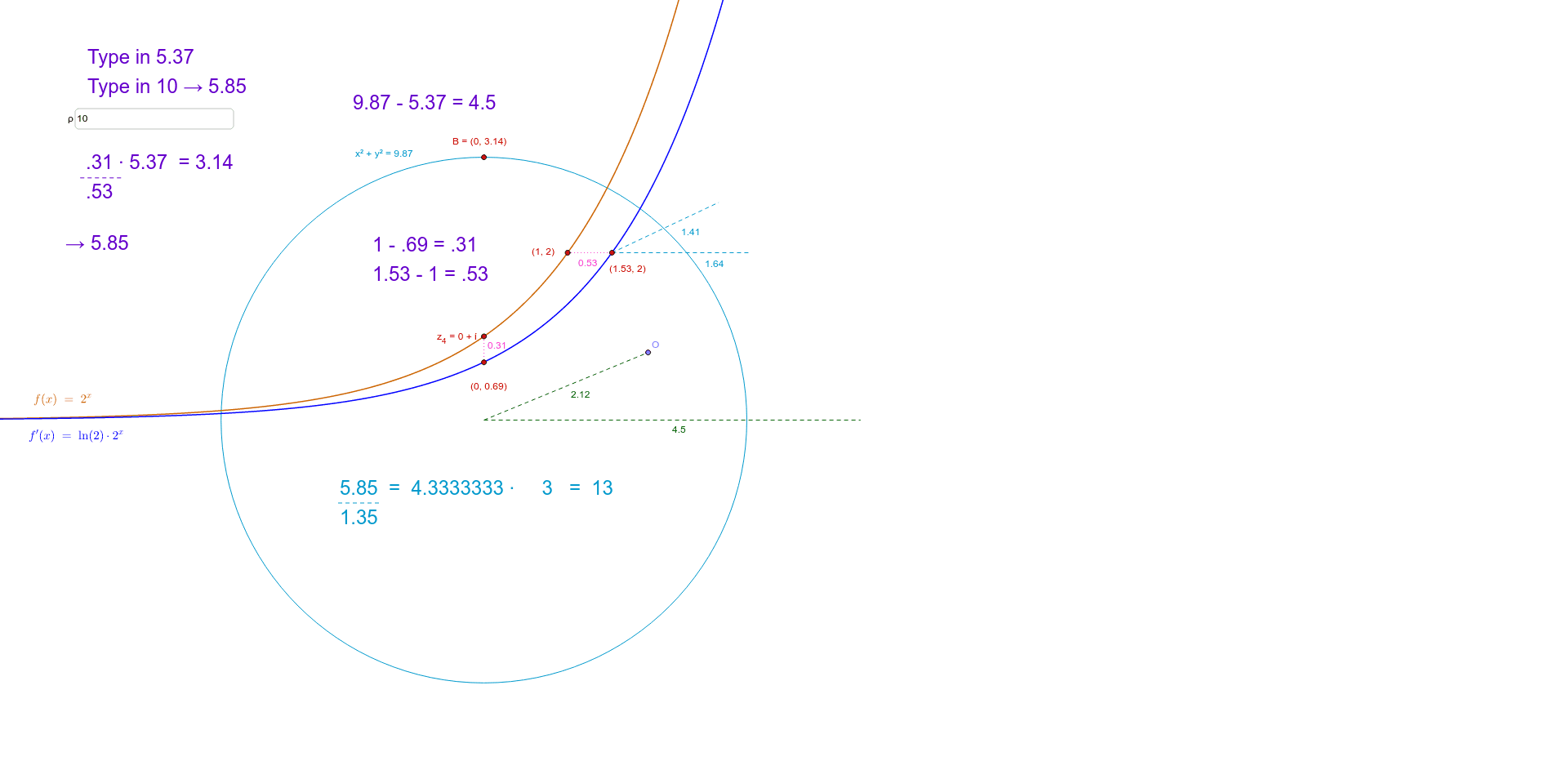
This example demonstrates the geometric representation of prime number 13, involving concepts like circles, triangles, and sequences. Construction uses GeoGebra commands such as Circle, PointIn, and Segment to create the figure. It is suitable for students in middle school and above to understand the relationship between prime numbers and geometric shapes, and to practice basic graphing techniques in coordinate geometry and sequences.
GeoGebra Commands & Parameters
Circle(A, B) → cPointIn(c) → PointcSegment(A, B) → bSegment(G, H) → ePoint(Circle[J, 1.64]) → KSegment(J, K) → gPoint(Circle[J, 1.41]) → LSegment(J, L) → hSegment(M, J) → jSegment(z_4, I) → kTextfield(ρ) → inputBox1Point(Circle[A, 4.5]) → NSegment(A, N) → nPoint(Circle[A, n^(0.5)]) → OSegment(A, O) → pSegment(G_1, H_1) → e_1
AI Drawing Prompt Reference
Draw a geometric figure related to the prime number 13, including a circle and several triangles. Start by drawing a large circle and marking a point on it. Then draw a large triangle and connect its vertices to two points on the circle with line segments. Finally, draw a square outside the large circle and connect one of its vertices to the center of the circle to show the relationship between prime numbers and geometric shapes.
The prompt above was compiled from the original drawing commands and is for reference only.