
Visualizing Roots of Complex Numbers: Equilateral Triangles on the Unit Circle
Loading the math board and drawing, please wait…
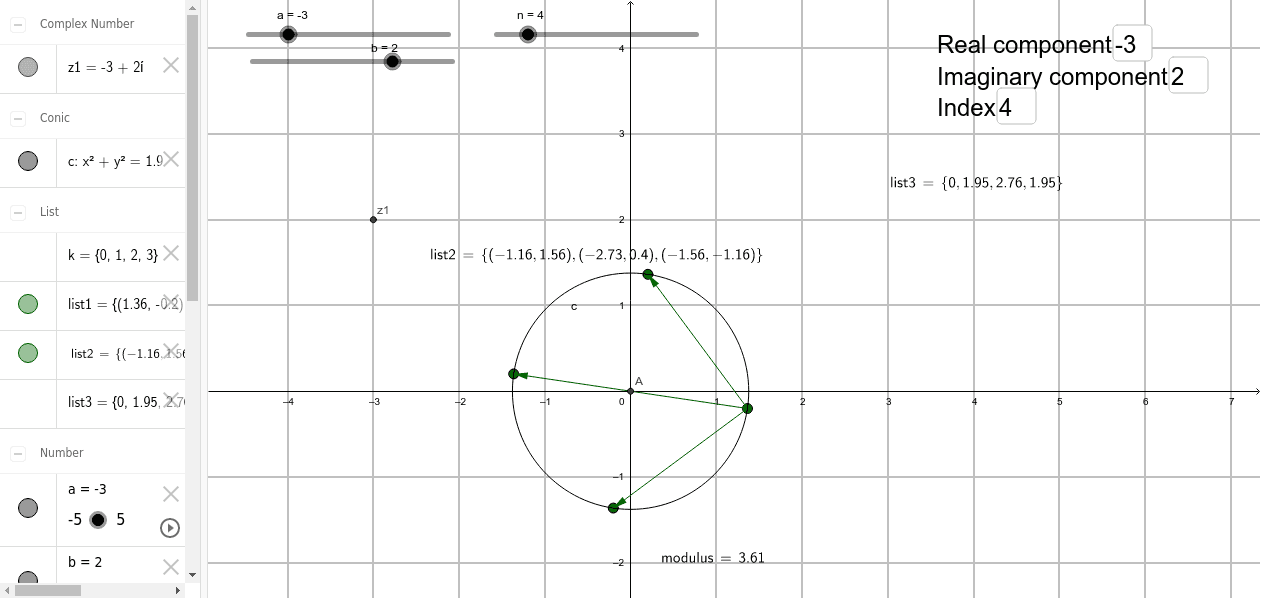
① This GeoGebra example dynamically illustrates the geometric meaning of taking the nth roots of a complex number: the n roots are evenly spaced on a circle centered at the origin with radius equal to the modulus, forming the vertices of a regular n-gon. ② Core mathematical concepts include polar representation of complex numbers (modulus and argument), De Moivre's theorem, roots of unity, and the connection between regular polygons and the complex plane. ③ Construction highlights: LaTeX and Textfield are used to create input boxes (InputBox1, InputBox2, InputBox3) for entering the real part, imaginary part, and root order n; the Sequence command generates the root sequence list1 for k from 0 to n-1; Intersect and Circle are used to construct the unit circle and intersection points, displaying each root as point A and connecting them to form equilateral triangles when n=3. ④ Suitable for high school to early college students to gain geometric intuition for complex arithmetic, and for math lab or inquiry-based learning to master the rules of complex root extraction from both algebraic and geometric perspectives.
GeoGebra Commands & Parameters
LaTeX(modulus, true, true) → text2LaTeX(theta, true, true) → text1Textfield(a) → InputBox1Textfield(b) → InputBox2Textfield(n) → InputBox3Sequence(0, n - 1) → kSequence(((modulus^(1 / n) * cos((theta + ((2 * π) * k)) / n)), (modulus^(1 / n) * sin((theta + ((2 * π) * k)) / n))), k, 0, n - 1, 1) → list1Sequence(Vector[((modulus^(1 / n) * cos(theta / n)), (modulus^(1 / n) * sin(theta / n))), ((modulus^(1 / n) * cos((theta + ((2 * π) * k)) / n)), (modulus^(1 / n) * sin((theta + ((2 * π) * k)) / n)))], k, 1, n - 1) → list2Sequence(Length[Vector[((modulus^(1 / n) * cos(theta / n)), (modulus^(1 / n) * sin(theta / n))), ((modulus^(1 / n) * cos((theta + ((2 * π) * k)) / n)), (modulus^(1 / n) * sin((theta + ((2 * π) * k)) / n)))]], k, 0, n - 1) → list3LaTeX(list3, true, true) → text3LaTeX(list2, true, true) → text4Intersect(xAxis, yAxis) → ACircle(A, modulus^(1 / n)) → c
AI Drawing Prompt Reference
Draw a unit circle and evenly space n complex roots on it to form a regular n-gon. First, input the real part a and imaginary part b of the complex number, and the root order n. Then, generate n complex roots based on the input, which will form equilateral triangles on the unit circle (when n=3). Use trigonometric functions to calculate the position of each root and connect them with line segments.
The prompt above was compiled from the original drawing commands and is for reference only.