
Poorly Drawn Parallelograms 3: Construction with Angles
Loading the math board and drawing, please wait…
In collections
Poorly Drawn Parallelograms 3
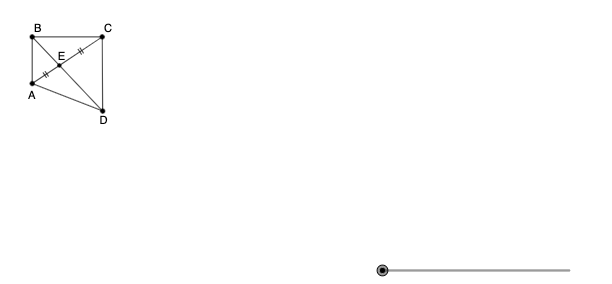
This example demonstrates how a parallelogram can still be generated from a point/segment structure even when the drawing is intentionally “poor,” emphasizing the role of geometric constraints. It focuses on concepts such as constructing a quadrilateral (parallelogram) from four points, using intersection relationships between sides/auxiliary segments, and employing angle information to maintain consistent orientation or direction. The construction is built with GeoGebra commands reflected in the summary: Polygon to form quadrilateral ABCD, Segment to create the sides and auxiliary lines, Intersect to locate key intersection points that govern connectivity, and Angle to define or visualize the critical angular constraints. Suitable for middle to high school geometry, lessons on parallelogram properties, and practice with geometric construction logic.
GeoGebra Commands & Parameters
Polygon(A, B, C, D) → q1, a, b, c, dSegment(B, D) → fSegment(A, C) → gIntersect(f, g) → ESegment(A, E) → hSegment(E, C) → iSegment(E, D) → jSegment(E, B) → kPolygon(A_{1}, B_{1}, C_{1}, D_{1}) → q1_{1}, a_{1}, b_{1}, c_{1}, d_{1}Segment(B_{1}, D_{1}) → f_{1}Segment(A_{1}, C_{1}) → g_{1}Intersect(f_{1}, g_{1}) → E_{1}Segment(A_{1}, E_{1}) → h_{1}Segment(E_{1}, C_{1}) → i_{1}Segment(E_{1}, D_{1}) → j_{1}Segment(E_{1}, B_{1}) → k_{1}Polygon(A_{2}, B_{2}, C_{2}, D_{2}) → q1_{2}, a_{2}, b_{2}, c_{2}, d_{2}Segment(B_{2}, D_{2}) → f_{2}Segment(A_{2}, C_{2}) → g_{2}Intersect(f_{2}, g_{2}) → E_{2}Segment(A_{2}, E_{2}) → h_{2}Segment(E_{2}, C_{2}) → i_{2}Segment(E_{2}, D_{2}) → j_{2}Segment(E_{2}, B_{2}) → k_{2}Polygon(A_{3}, B_{3}, C_{3}, D_{3}) → q1_{3}, a_{3}, b_{3}, c_{3}, d_{3}Segment(B_{3}, D_{3}) → f_{3}Segment(A_{3}, C_{3}) → g_{3}Intersect(f_{3}, g_{3}) → E_{3}Segment(A_{3}, E_{3}) → h_{3}Segment(E_{3}, C_{3}) → i_{3}Segment(E_{3}, D_{3}) → j_{3}Segment(E_{3}, B_{3}) → k_{3}Polygon(A_{4}, B_{4}, C_{4}, D_{4}) → q1_{4}, a_{4}, b_{4}, c_{4}, d_{4}Segment(B_{4}, D_{4}) → f_{4}Segment(A_{4}, C_{4}) → g_{4}Intersect(f_{4}, g_{4}) → E_{4}Segment(A_{4}, E_{4}) → h_{4}Segment(E_{4}, C_{4}) → i_{4}Segment(E_{4}, D_{4}) → j_{4}Segment(E_{4}, B_{4}) → k_{4}Polygon(A_{5}, B_{5}, C_{5}, D_{5}) → q1_{5}, a_{5}, b_{5}, c_{5}, d_{5}Segment(B_{5}, D_{5}) → f_{5}Segment(A_{5}, C_{5}) → g_{5}Intersect(f_{5}, g_{5}) → E_{5}Segment(A_{5}, E_{5}) → h_{5}Segment(E_{5}, C_{5}) → i_{5}Segment(E_{5}, D_{5}) → j_{5}Segment(E_{5}, B_{5}) → k_{5}Polygon(A_{6}, B_{6}, C_{6}, D_{6}) → q1_{6}, a_{6}, b_{6}, c_{6}, d_{6}Segment(B_{6}, D_{6}) → f_{6}Segment(A_{6}, C_{6}) → g_{6}Intersect(f_{6}, g_{6}) → E_{6}Segment(A_{6}, E_{6}) → h_{6}Segment(E_{6}, C_{6}) → i_{6}Segment(E_{6}, D_{6}) → j_{6}Segment(E_{6}, B_{6}) → k_{6}Polygon(A_{7}, B_{7}, C_{7}, D_{7}) → q1_{7}, a_{7}, b_{7}, c_{7}, d_{7}Segment(B_{7}, D_{7}) → f_{7}Segment(A_{7}, C_{7}) → g_{7}Intersect(f_{7}, g_{7}) → E_{7}Segment(A_{7}, E_{7}) → h_{7}Segment(E_{7}, C_{7}) → i_{7}Segment(E_{7}, D_{7}) → j_{7}Segment(E_{7}, B_{7}) → k_{7}Angle(C_{3}, E_{3}, B_{3}) → αAngle(D_{3}, E_{3}, C_{3}) → βAngle(C_{7}, E_{7}, B_{7}) → γAngle(D_{7}, E_{7}, C_{7}) → δPolygon(A_{8}, B_{8}, C_{8}, D_{8}) → q1_{8}, a_{8}, b_{8}, c_{8}, d_{8}Segment(B_{8}, D_{8}) → f_{8}Segment(A_{8}, C_{8}) → g_{8}Intersect(f_{8}, g_{8}) → E_{8}Segment(A_{8}, E_{8}) → h_{8}Segment(E_{8}, C_{8}) → i_{8}Segment(E_{8}, D_{8}) → j_{8}Segment(E_{8}, B_{8}) → k_{8}Angle(C_{8}, E_{8}, B_{8}) → γ_{1}Angle(D_{8}, E_{8}, C_{8}) → δ_{1}Polygon(A_{9}, B_{9}, C_{9}, D_{9}) → q1_{9}, a_{9}, b_{9}, c_{9}, d_{9}Segment(B_{9}, D_{9}) → f_{9}Segment(A_{9}, C_{9}) → g_{9}Intersect(f_{9}, g_{9}) → E_{9}Segment(A_{9}, E_{9}) → h_{9}Segment(E_{9}, C_{9}) → i_{9}Segment(E_{9}, D_{9}) → j_{9}Segment(E_{9}, B_{9}) → k_{9}Angle(C_{9}, E_{9}, B_{9}) → γ_{2}Angle(D_{9}, E_{9}, C_{9}) → δ_{2}
AI Drawing Prompt Reference
Draw a parallelogram. Choose four points A, B, C, D. Draw line segments BD and AC, and find their intersection point E. Connect A to E, E to C, E to D, and E to B to form the quadrilateral ABCD. This construction emphasizes using the intersection to define the shape.
The prompt above was compiled from the original drawing commands and is for reference only.