
Polygon and Linear Regression Animation Demo
Loading the math board and drawing, please wait…
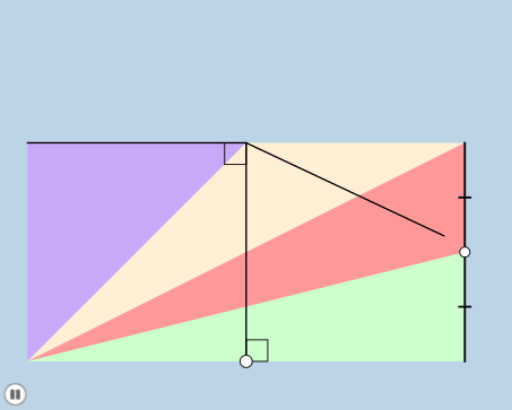
This example demonstrates geometric relationships and transformations involving polygons, linear regression, circles, prisms, and circumcircles through animation. Key math concepts include polygon construction, linear regression analysis, circle properties, prism volume calculation, and circumcircle determination. GeoGebra commands and objects used in construction are Polygon, Midpoint, Segment, Line, OrthogonalLine, Intersect, Angle, Dilate, Rotate, Vector, and Translate. Suitable for high school and above learners to understand the integration of spatial geometry and data analysis.
GeoGebra Commands & Parameters
Polygon(A, B, 4) → poly1, f, g, h, i, C, DPolygon(B, E, 4) → poly2, j, k, l, m, F, GMidpoint(E, F) → HSegment(A, H) → nSegment(A, F) → pSegment(A, C) → qSegment(C, B) → rLine(A, C) → sOrthogonalLine(F, s) → tOrthogonalLine(D, q) → bOrthogonalLine(C, p) → cOrthogonalLine(H, p) → dIntersect(c, p) → IIntersect(d, p) → JLine(A, H) → eOrthogonalLine(F, e) → f_1OrthogonalLine(E, n) → g_1Intersect(e, g_1) → KIntersect(e, f_1) → LIntersect(b, q) → MAngle(C, M, D) → αAngle(C, I, A) → βAngle(H, J, F) → γIntersect(s, t) → NAngle(C, N, F) → δAngle(F, L, H) → εAngle(A, K, E) → ζPolygon(A, C, D) → poly3, d_1, a_1, c_1Polygon(A, F, C) → poly4, c_2, a_2, f_2Polygon(A, H, F) → poly5, f_3, a_3, h_1Polygon(A, E, H) → poly6, h_2, a_4, e_1Dilate(E, If[0 < o ≤ 1, 1 - o, 0], H) → E'Segment(E, E') → i_1Angle(F, E, B) → ηAngle(D, F, E) → θAngle(A, D, F) → ιAngle(E, A, D) → κRotate(E, If[1 < o ≤ 2, ((-(o - 1)) * π), (-π)], H) → E'_1Rotate(E', If[1 < o ≤ 2, ((-(o - 1)) * π), (-π)], H) → E''Segment(E'_1, E'') → j_1Dilate(F, If[2 < o ≤ 3, 3 - o, 0], G) → F'Rotate(E, If[2 < o ≤ 3, ((-(o - 2)) * π / 2), ((-π)) / 2], F) → E'_2Rotate(E', If[2 < o ≤ 3, ((-(o - 2)) * π / 2), ((-π)) / 2], F) → E''_1Rotate(E'_1, If[2 < o ≤ 3, ((-(o - 2)) * π / 2), ((-π)) / 2], F) → ORotate(E'', If[2 < o ≤ 3, ((-(o - 2)) * π / 2), ((-π)) / 2], F) → E'''Angle(D, C, B) → λAngle(E, B, C) → μSegment(A, E) → n_1Segment(D, A) → p_1Segment(D, C) → k_1Rotate(D, If[2 < o ≤ 3, ((o - 2) * π / 2), π / 2], G) → D'Rotate(C, If[2 < o ≤ 3, ((o - 2) * π / 2), π / 2], G) → C'Segment(D', C') → l_1Rotate(D', If[3 < o ≤ 4, ((o - 3) * π / 2), π / 2], G) → D''Rotate(C', If[3 < o ≤ 4, ((o - 3) * π / 2), π / 2], G) → C''Segment(D'', C'') → m_1Dilate(A, If[4 < o ≤ 5, 5 - o, 0], G) → A'Segment(A, A') → q_1Dilate(D, If[4 < o ≤ 5, 5 - o, 0], M) → D'_1Segment(D, D'_1) → r_1Dilate(G, If[5 < o ≤ 6, 6 - o, 0], N) → G'Dilate(F, If[5 < o ≤ 6, 6 - o, 0], N) → F'_1Segment(G, G') → s_1Segment(F, F'_1) → t_1Rotate(D, If[6 < o ≤ 7, ((o - 6) * π), π], G) → D'_2Rotate(D'_1, If[6 < o ≤ 7, ((o - 6) * π), π], G) → PDilate(D, If[6 < o ≤ 7, 7 - o, 0], N) → D'_3Vector(D, D'_3) → uTranslate(D, u) → D'_4Translate(D'_1, u) → QSegment(D'_4, Q) → b_1Dilate(A, If[7 < o ≤ 8, 8 - o, 0], F) → A'_1Segment(A, A'_1) → g_2Dilate(G, If[8 < o ≤ 9, 9 - o, 0], I) → G'_1Dilate(H, If[8 < o ≤ 9, 9 - o, 0], J) → H'Segment(G, G'_1) → i_2Segment(H, H') → j_2Dilate(A, If[7 < o ≤ 8, 8 - o, 0], H) → A'_2Segment(A, A'_2) → k_2Dilate(G, If[9 < o ≤ 10, 10 - o, 0], J) → G'_2Vector(G, G'_2) → vTranslate(G, v) → G'_3Translate(G'_1, v) → RSegment(G'_3, R) → l_2Dilate(H, If[10 < o ≤ 11, 11 - o, 0], L) → H'_1Dilate(F, If[10 < o ≤ 11, 11 - o, 0], L) → F'_2Segment(F, F'_2) → n_2Dilate(E, If[10 < o ≤ 11, 11 - o, 0], K) → E'_3Segment(E, E'_3) → m_2Segment(H, H'_1) → p_2Dilate(L, If[11 < o ≤ 12, 12 - o, 0], E) → L'Vector(L, L') → wTranslate(F, w) → F'_3Translate(F'_2, w) → SSegment(F'_3, S) → q_2Dilate(D, If[0 < o ≤ 1, 1 - o, 0], G) → D'_5Segment(D, D'_5) → r_2
AI Drawing Prompt Reference
Draw a quadrilateral ABCD, then draw a quadrilateral BEFG. Find the midpoint H of E and F, connect AH and AF, then draw the perpendiculars t and b to AC and BC, and the perpendiculars c and d to AH and AF, find their intersections I and J, then draw AH and its perpendiculars f_1 and g_1, find their intersections with AC and AF to get K and L, then find the intersection M of b and q, calculate angles α, β, γ, δ, ε, and ζ, then draw triangles ACD, ACF, AHF, and AEH, then rotate E and E' around H, connect E' and E'', then rotate F and F' around G, rotate E', E''_1, and E''' around F, and finally calculate angles λ and μ.
The prompt above was compiled from the original drawing commands and is for reference only.