
Polar Reciprocals: A Cardiod and A Parabola
Loading the math board and drawing, please wait…
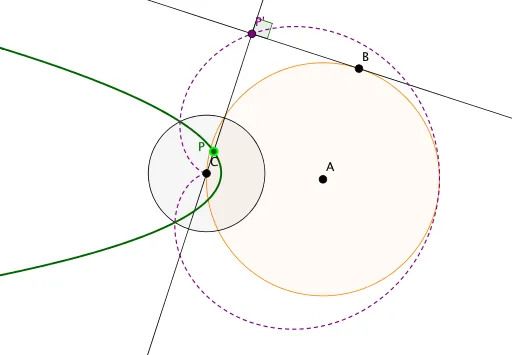
This example demonstrates the reciprocal relationship between a cardioid and a parabola in polar coordinates, showcasing their geometric properties and intersections. It involves core concepts like polar equations, curve intersections, and geometric transformations. The construction utilizes GeoGebra commands and objects such as Point, Circle, Rotate, Tangent, OrthogonalLine, Angle, Intersect, Mirror, and Locus with parameters α, A, B_1, c, C, d, B, f, h, g, β, P', P, loc1, loc2, PP. Suitable for high school and advanced learners exploring dynamic geometry and curve analysis.
GeoGebra Commands & Parameters
Point(yAxis) → APoint(xAxis) → B_1Circle(A, B_1) → cPoint(c) → CCircle(C, 1) → dRotate(B_1, α) → BTangent(B, c) → f, hOrthogonalLine(C, f) → gAngle(g, f) → βIntersect(f, g) → P'Mirror(P', d) → PLocus(P, α) → loc1Locus(P', α) → loc2
AI Drawing Prompt Reference
Draw a cardioid and a parabola in polar coordinates to demonstrate their reciprocal relationship. Start by drawing two perpendicular lines, one along the x-axis and the other along the y-axis. Create a circle centered at their intersection, then draw another circle centered at the same point with radius 1. Rotate the line along the x-axis by an angle α, find the tangent from this rotated line to the first circle, and determine the intersection point of this tangent with a line through the circle's center that is perpendicular to the tangent. Reflect this intersection point across the second circle to get another point. Finally, trace the paths of these two points as the angle α varies to form the cardioid and the parabola.
The prompt above was compiled from the original drawing commands and is for reference only.