
Conics by Polar Reciprocation
Loading the math board and drawing, please wait…
In collections
Non-traditional Conic Constructions
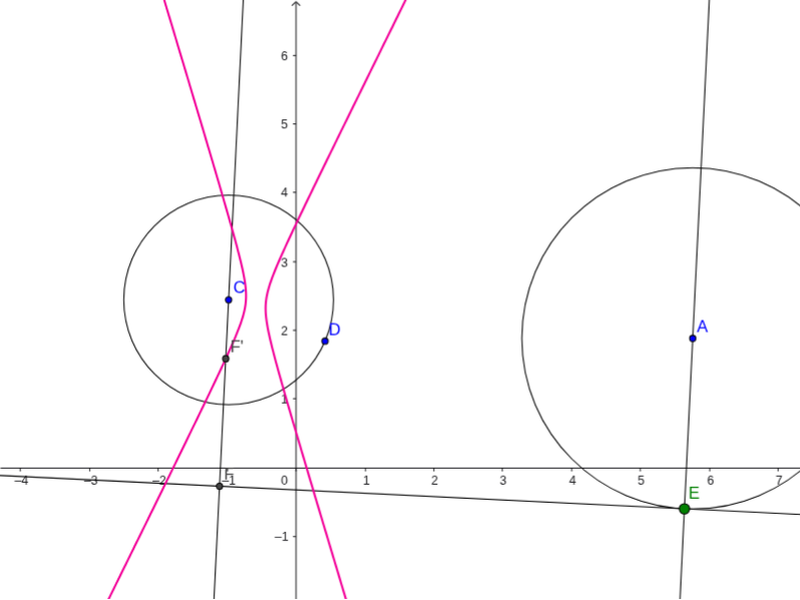
This example demonstrates the construction of conic sections using polar reciprocation. Key mathematical concepts involved include polar and Cartesian coordinate transformations, and the definitions and properties of conic sections. The construction utilizes GeoGebra commands and objects such as Circle, Point, Line, OrthogonalLine, Intersect, Mirror, and Locus. Suitable for high school and above students to understand the geometric construction of conic sections and their relationship with polar coordinates.
GeoGebra Commands & Parameters
Circle(A, B) → cCircle(C, D) → dPoint(c) → ELine(A, E) → aOrthogonalLine(E, a) → bOrthogonalLine(C, b) → eIntersect(b, e) → FMirror(F, d) → F'Locus(F', E) → loc1
AI Drawing Prompt Reference
Draw two circles, each defined by a center and a point on its circumference. Pick a moving point on the first circle, connect it to the first center with a line, then construct a perpendicular to this line through the moving point. Through the second center, draw another perpendicular to the previous perpendicular, and mark their intersection. Reflect this intersection across the second circle to get a new point. Finally, trace the locus of this reflected point as the moving point travels along the first circle, producing a conic section.
The prompt above was compiled from the original drawing commands and is for reference only.