
Points of Intersection 17: Mirror Polygons and Incircle Intersections
Loading the math board and drawing, please wait…
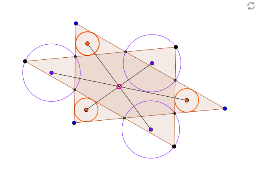
This example demonstrates a geometric construction where a triangle is mirrored, incircles are drawn, and multiple intersection points are computed, incorporating natural numbers, combinatorics, and the tangent function. The core mathematical concepts include two-dimensional vectors, polygon reflection, incircle properties, intersection of lines and circles, and the geometric interpretation of the tangent function. The construction uses GeoGebra commands such as Polygon to create the initial triangle poly1, Mirror to generate the reflected triangle poly1', Incircle to construct incircles, and Intersect to find points D through P where sides, circles, and mirrored elements meet. Objects include A, B, C, poly1, c, a, b, A', B', C', poly1', c', a', b', D, E, F, G, H, I, d, inc_1, e, inc_2, f, inc, J, K, L, g, h, k, M, N, O, i, j, l, P. Suitable for high school and college students exploring geometric transformations, combinatorial patterns, and trigonometric functions, as well as for teachers demonstrating dynamic geometry constructions.
GeoGebra Commands & Parameters
Polygon(A, B, C) → poly1, c, a, bMirror(A, Centroid[Polygon[A, B, C]]) → A'Mirror(B, Centroid[Polygon[A, B, C]]) → B'Mirror(C, Centroid[Polygon[A, B, C]]) → C'Polygon(A', B', C') → poly1', c', a', b'Intersect(poly1, poly1') → D, E, F, G, H, IIncircle(A, D, I) → dIncircle(C, H, F) → eIncircle(B, G, E) → fCenter(d) → JCenter(f) → KCenter(e) → LCircle(D, C', E) → gCircle(G, F, A') → hCircle(B', I, H) → kCenter(g) → MCenter(k) → NCenter(h) → OSegment(J, O) → iSegment(N, K) → jSegment(M, L) → lIntersect(i, l) → P
AI Drawing Prompt Reference
Draw an arbitrary triangle. Reflect this triangle about its centroid to create a second, mirrored triangle. The two triangles intersect, producing six intersection points. Using these points, construct three incircles associated with the original and mirrored triangles, and mark their centers. Then, draw three circles, each passing through a set of three intersection points, and mark their centers as well. Connect the centers of corresponding incircles and new circles with line segments, and find the intersection point of two of these segments. The final figure shows two mirrored triangles, several circles, connecting segments, and a single intersection point, illustrating symmetry, incircle properties, and combinatorial intersections.
The prompt above was compiled from the original drawing commands and is for reference only.