
Points of Intersection 10: Exploring Intersections in a Cuboid Framework
Loading the math board and drawing, please wait…
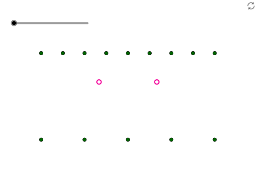
This GeoGebra example demonstrates the dynamic construction of intersection points within a cuboid framework, where multiple polylines and scalene triangles are created and their intersections are computed. The core mathematical concepts include spatial geometry, intersection of lines and segments, properties of triangles and parallelograms, and the use of real-number parameters in sequences. The construction employs commands such as Sequence to generate point lists, PolyLine to draw connected segments, and Intersect to calculate crossing points, all within a cuboid base. It also involves scalene triangles and parallelograms as auxiliary shapes. This example is suitable for high school or early college students to visualize how intersection points emerge in 3D-like configurations and to practice using dynamic geometry tools for exploring complex spatial relationships.
GeoGebra Commands & Parameters
Sequence((a, 4), a, -4, 4) → list1Sequence((a, 0), a, -4, 4, 2) → list2Point(list2) → APoint(list1) → BPoint(list2) → CPoint(list1) → DPoint(list2) → EPoint(list1) → FPoint(list2) → GPoint(list1) → HPoint(list2) → IPolyLine(A, B, C, D, E, F, G, H, I) → aPoint(list1) → JPoint(list1) → KPolyLine(A, J, E, K, I) → bPoint(list1) → LPolyLine(A, L, I) → cIntersect(c, a) → M, N, O, P, Q, R, S, T