
Pointed Hats
Loading the math board and drawing, please wait…
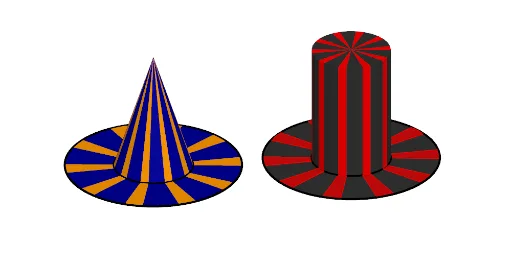
This example demonstrates the geometric shape of pointed hats. It involves concepts of cones and circles. Using GeoGebra commands such as Sequence, CurveCartesian, and Join, the pointed hat can be constructed. Suitable for high school geometry and calculus courses.
GeoGebra Commands & Parameters
Sequence((x(O), y(O)) - (R * (((sin(0°) * sin(i°)) * w) + ((cos(0°) * sin(i°)) * u) - (cos(i°) * v))), i, 0, k, n) → liste1CurveCartesian(x(O - (R * (((0 * sin(i°)) * w) + (sin(i°) * u) - (cos(i°) * v)))), y(O - (R * (((0 * sin(i°)) * w) + (sin(i°) * u) - (cos(i°) * v)))), i, 0, k) → dJoin(liste1) → liste2Sequence(Polygon[O', Element[liste1, i], Element[liste1, i + 1]], i, 0, Length[liste1] + 2, 1) → liste3Sequence(Polygon[O', Element[liste1, i], Element[liste1, i + 1]], i, 0, Length[liste1] + 2, 3) → liste4Sequence((x(O), y(O)) - ((R + h / 2.5) * (((sin(0°) * sin(i°)) * w) + ((cos(0°) * sin(i°)) * u) - (cos(i°) * v))), i, 0, k, n) → liste5Sequence(Polygon[Element[liste1, i], Element[liste1, i + 1], Element[liste5, i + 1], Element[liste5, i]], i, 0, Length[liste1] + 2, 1) → liste6Sequence(Polygon[Element[liste1, i], Element[liste1, i + 1], Element[liste5, i + 1], Element[liste5, i]], i, 0, Length[liste1] + 2, 3) → liste7CurveCartesian(x(O - ((R + h / 2.5) * (((0 * sin(i°)) * w) + (sin(i°) * u) - (cos(i°) * v)))), y(O - ((R + h / 2.5) * (((0 * sin(i°)) * w) + (sin(i°) * u) - (cos(i°) * v)))), i, 0, k) → eSequence((x(A), y(A)) - (R * (((sin(0°) * sin(i°)) * w) + ((cos(0°) * sin(i°)) * u) - (cos(i°) * v))), i, 0, k, n) → liste8Sequence((x(A'), y(A')) - (R * (((sin(0°) * sin(i°)) * w) + ((cos(0°) * sin(i°)) * u) - (cos(i°) * v))), i, 0, k, n) → liste9Sequence((x(A), y(A)) - ((R + h / 2.5) * (((sin(0°) * sin(i°)) * w) + ((cos(0°) * sin(i°)) * u) - (cos(i°) * v))), i, 0, k, n) → liste10Sequence(Polygon[Element[liste8, i], Element[liste8, i + 1], Element[liste9, i + 1], Element[liste9, i]], i, 0, Length[liste9] + 2, 1) → liste11Sequence(Polygon[Element[liste8, i], Element[liste8, i + 1], Element[liste9, i + 1], Element[liste9, i]], i, 0, Length[liste9] + 2, 3) → liste12Sequence(Polygon[Element[liste8, i], Element[liste8, i + 1], Element[liste10, i + 1], Element[liste10, i]], i, 0, Length[liste8] + 2, 1) → liste13Sequence(Polygon[Element[liste8, i], Element[liste8, i + 1], Element[liste10, i + 1], Element[liste10, i]], i, 0, Length[liste8] + 2, 3) → liste14CurveCartesian(x(A - (R * (((0 * sin(i°)) * w) + (sin(i°) * u) - (cos(i°) * v)))), y(A - (R * (((0 * sin(i°)) * w) + (sin(i°) * u) - (cos(i°) * v)))), i, 0, k) → fCurveCartesian(x(A' - (R * (((0 * sin(i°)) * w) + (sin(i°) * u) - (cos(i°) * v)))), y(A' - (R * (((0 * sin(i°)) * w) + (sin(i°) * u) - (cos(i°) * v)))), i, 0, k) → iCurveCartesian(x(A - ((R + h / 2.5) * (((0 * sin(i°)) * w) + (sin(i°) * u) - (cos(i°) * v)))), y(A - ((R + h / 2.5) * (((0 * sin(i°)) * w) + (sin(i°) * u) - (cos(i°) * v)))), i, 0, k) → jSequence(A' + ((R * cos(i° + 90°)), (R * sin(i° + 90°)), 0), i, 0, k, n) → liste17Sequence(Polygon[Element[liste17, i], Element[liste17, i + 1], Element[liste9, i + 1], Element[liste9, i]], i, 0, Length[liste9] + 2, 1) → l2Sequence(Polygon[Element[liste17, i], Element[liste17, i + 1], Element[liste9, i + 1], Element[liste9, i]], i, 0, Length[liste9] + 2, 3) → l1Sequence(Polygon[Element[liste17, i], Element[liste17, i + 1], A'], i, 0, Length[liste8] + 2, 1) → l3Sequence(Polygon[Element[liste17, i], Element[liste17, i + 1], A'], i, 0, Length[liste8] + 2, 3) → l4Point(j) → BMirror(B, A) → B'Segment(B, B') → lSegment(A, A') → mPoint(e) → CMirror(C, O) → C'Segment(C, C') → p
AI Drawing Prompt Reference
Draw a geometric pointed hat shape involving cones and circles. First, create the curve for the hat's top, then construct the curve for the brim, fill the top and brim areas with polygons, and finally connect the top and brim to form the complete pointed hat.
The prompt above was compiled from the original drawing commands and is for reference only.