
Plastic Ratio Calipers
Loading the math board and drawing, please wait…
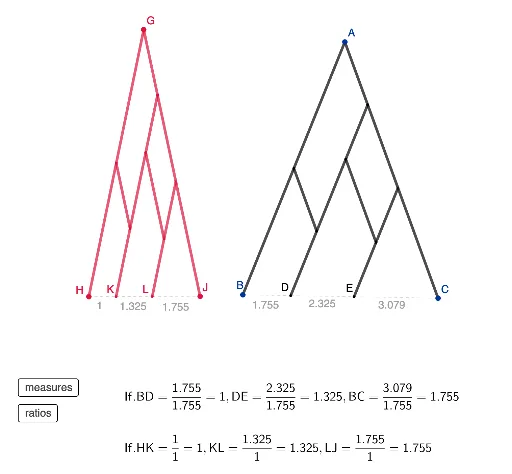
This is a caliper model designed to measure the plastic ratio. Through geometric construction, we can intuitively understand the concept of ratio. The core mathematical concepts involved include ratio, similarity transformation, and geometric construction. Using GeoGebra commands such as Circle, Point, Segment, Intersect, Line, Midpoint, and Distance, an accurate caliper model can be constructed. Suitable for high school mathematics education and learning about ratio concepts.
GeoGebra Commands & Parameters
Circle(A, 10) → cPoint(c) → BPoint(c) → CSegment(A, B) → fSegment(A, C) → gPoint(Circle[B, 4.0795]) → D_2Circle(A, 2.4513) → pCircle(A, 5.6985) → qIntersect(p, g, 1) → G_2Intersect(q, g, 1) → H_2Line(G_2, f) → iLine(H_2, i) → jCircle(H_2, 2.1508) → rIntersect(r, j, 2) → ILine(I, g) → lIntersect(i, l) → J_2Midpoint(A, B) → K_2Line(K_2, l) → mIntersect(i, m) → L_2Segment(B, C) → hIntersect(i, h) → DIntersect(j, h) → ESegment(H_2, E) → kSegment(G_2, D) → nSegment(J_2, I) → sSegment(K_2, L_2) → tCircle(G, 10) → c_1Point(c_1) → HPoint(c_1) → JSegment(G, H) → f_1Segment(G, J) → g_1Point(Circle[H, 4.0795]) → D_1Circle(G, 2.4513) → p_1Circle(G, 5.6985) → q_1Intersect(p_1, g_1, 1) → G_1Intersect(q_1, g_1, 1) → H_1Line(G_1, f_1) → i_1Line(H_1, i_1) → j_1Circle(H_1, 2.1508) → r_1Intersect(r_1, j_1, 2) → I_1Line(I_1, g_1) → l_1Intersect(i_1, l_1) → J_1Midpoint(G, H) → K_1Line(K_1, l_1) → m_1Intersect(i_1, m_1) → L_1Segment(H, J) → h_1Intersect(i_1, h_1) → KIntersect(j_1, h_1) → LSegment(H_1, L) → k_1Segment(G_1, K) → n_1Segment(J_1, I_1) → s_1Segment(K_1, L_1) → t_1Segment(B, D) → e_1Segment(D, E) → f_2Segment(E, C) → g_2Segment(H, K) → h_2Segment(K, L) → i_2Segment(L, J) → j_2Distance(D, E) → DEDistance(B, D) → BEDistance(E, C) → ECDistance(H, K) → HKDistance(L, K) → KLDistance(L, J) → LJ
AI Drawing Prompt Reference
Create a caliper model to understand the concept of ratio through geometric construction. Start by drawing two circles with point A as the center, then get points B and C. Construct line segments AB and AC. Use circles and line segments to find other key points and segments, such as f, g, h, i, and j, and their relationships to form the caliper model.
The prompt above was compiled from the original drawing commands and is for reference only.