
Perimeter Challenge by spkwan
Loading the math board and drawing, please wait…
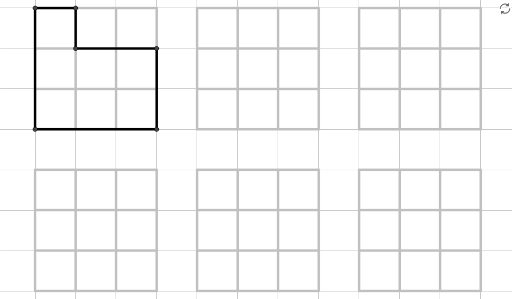
This example demonstrates exploring perimeter variations through dynamic geometric constructions. Core math concepts include perimeter calculation, translation transformations, differential equations, special points identification, bar chart plotting, and correlation analysis. GeoGebra commands like Segment, Point, and Intersect are used in the construction. Suitable for high school and above learners to understand the integration of geometric transformations and data analysis.
GeoGebra Commands & Parameters
Segment(A, B) → aSegment(C, D) → bSegment(A, C) → cSegment(B, D) → dPoint(c) → EPoint(d) → FSegment(E, F) → ePoint(c) → GPoint(d) → HSegment(G, H) → fPoint(a) → IPoint(b) → JSegment(I, J) → gSegment(K, L) → hSegment(M, N) → iSegment(O, P) → jSegment(M, O) → kSegment(N, P) → lPoint(k) → QPoint(l) → RSegment(Q, R) → mPoint(k) → SPoint(l) → TSegment(S, T) → nPoint(i) → UPoint(j) → VSegment(U, V) → pPoint(i) → WPoint(j) → ZSegment(W, Z) → qSegment(A_1, B_1) → rSegment(C_1, D_1) → sSegment(A_1, C_1) → tSegment(B_1, D_1) → a_1Point(t) → E_1Point(a_1) → F_1Segment(E_1, F_1) → b_1Point(t) → G_1Point(a_1) → H_1Segment(G_1, H_1) → c_1Point(s) → J_1Segment(I_1, J_1) → d_1Point(r) → K_1Point(s) → L_1Segment(K_1, L_1) → e_1Segment(M_1, N_1) → f_1Segment(O_1, P_1) → g_1Segment(M_1, O_1) → h_1Segment(N_1, P_1) → i_1Point(h_1) → Q_1Point(i_1) → R_1Segment(Q_1, R_1) → j_1Point(h_1) → S_1Point(i_1) → T_1Segment(S_1, T_1) → k_1Point(f_1) → U_1Point(g_1) → V_1Segment(U_1, V_1) → l_1Point(f_1) → W_1Point(g_1) → Z_1Segment(W_1, Z_1) → m_1Segment(A_2, B_2) → n_1Segment(C_2, D_2) → p_1Segment(A_2, C_2) → q_1Segment(B_2, D_2) → r_1Point(q_1) → E_2Point(r_1) → F_2Segment(E_2, F_2) → s_1Point(q_1) → G_2Point(r_1) → H_2Segment(G_2, H_2) → t_1Point(n_1) → I_2Segment(I_2, J_2) → a_2Point(n_1) → K_2Point(p_1) → L_2Segment(K_2, L_2) → b_2Segment(M_2, N_2) → c_2Segment(O_2, P_2) → d_2Segment(M_2, O_2) → e_2Segment(N_2, P_2) → f_2Point(e_2) → Q_2Point(f_2) → R_2Segment(Q_2, R_2) → g_2Point(e_2) → S_2Point(f_2) → T_2Segment(S_2, T_2) → h_2Point(c_2) → U_2Point(d_2) → V_2Segment(U_2, V_2) → i_2Point(c_2) → W_2Point(d_2) → Z_2Segment(W_2, Z_2) → j_2Segment(A_3, B_3) → k_2Segment(C_3, D_3) → l_2Segment(A_3, C_3) → m_2Segment(B_3, D_3) → n_2Point(m_2) → E_3Point(n_2) → F_3Segment(E_3, F_3) → p_2Point(m_2) → G_3Point(n_2) → H_3Segment(G_3, H_3) → q_2Point(k_2) → I_3Point(l_2) → J_3Segment(I_3, J_3) → r_2Point(k_2) → K_3Point(l_2) → L_3Segment(K_3, L_3) → s_2Segment(M_3, N_3) → t_2Segment(O_3, P_3) → a_3Segment(M_3, O_3) → b_3Segment(N_3, P_3) → c_3Point(b_3) → Q_3Point(c_3) → R_3Segment(Q_3, R_3) → d_3Point(b_3) → S_3Point(c_3) → T_3Segment(S_3, T_3) → e_3Point(t_2) → U_3Point(a_3) → V_3Segment(U_3, V_3) → f_3Point(t_2) → W_3Point(a_3) → Z_3Segment(W_3, Z_3) → g_3Segment(A_4, B_4) → h_3Segment(C_4, D_4) → i_3Segment(E_4, F_4) → j_3Segment(G_4, H_4) → k_3Segment(A_4, G_4) → l_3Point(h_3) → I_4Point(k_3) → J_4Segment(I_4, J_4) → m_3Point(h_3) → K_4Point(k_3) → L_4Segment(K_4, L_4) → n_3Segment(B_4, H_4) → p_3Intersect(a, c) → M_4Intersect(a, g) → N_4Intersect(e, g) → O_4Intersect(d, e) → P_4Intersect(b, d) → Q_4Intersect(b, c) → R_4Segment(M_4, N_4) → q_3Segment(N_4, O_4) → r_3Segment(O_4, P_4) → s_3Segment(P_4, Q_4) → t_3Segment(Q_4, R_4) → a_4Segment(R_4, M_4) → b_4