
Pentakis Dodecahedron and Its Dual Truncated Icosahedron: Edge/Face Coloring via
Loading the math board and drawing, please wait…
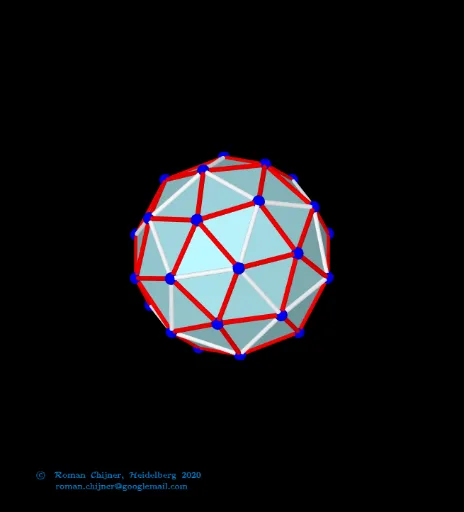
This example visualizes how a Pentakis Dodecahedron (V=32) and its dual image— the Truncated Icosahedron (V=60)—can be rendered with consistent coloring of edges and faces. The goal is to reveal the structural correspondence and symmetry between the primal solid and its dual when embedded in a spherical geometric setup. Key mathematics includes solid duality, convex regular polyhedra geometry, spherical reference constructions, and rule-based classification for coloring. Construction-wise, the model builds a reference Sphere and uses PointIn to test membership/conditions for points. It creates supporting geometry with Circle and Segment, and uses Angle measurements for classification cues. The example then applies If and KeepIf to filter and group elements that satisfy criteria, while Sort and First select ordered candidates. Iterative creation is organized with Sequence, and user-facing labeling is done with Textfield, TableText, and UnicodeToLetter, producing informative annotations (e.g., mapping/parameter readouts such as volume-related values). Suitable for high school advanced geometry through undergraduate visualization projects, and ideal for teaching dual polyhedra, symmetry, and geometry-driven coloring algorithms in GeoGebra.
GeoGebra Commands & Parameters
Sequence(((zoom * Element[Element[A00d, i], 1]), (zoom * Element[Element[A00d, i], 2]), (zoom * Element[Element[A00d, i], 3])), i, 1, Length[A00d]) → A0dSequence(((zoom * Element[Element[A00, i], 1]), (zoom * Element[Element[A00, i], 2]), (zoom * Element[Element[A00, i], 3])), i, 1, Length[A00]) → A0Sphere(O, r_o) → sp02dTextfield(R1sphere) → InputBox5Sphere(O, R1sphere) → sp01Textfield(r_o) → InputBox6Textfield(jarc) → InputBox8Textfield(jarc_d) → InputBox9Textfield(f_{Poly}) → InputBox11Textfield(k) → InputBox15Textfield(k_d) → InputBox14TableText({Append["i", 1…Length[mm5a]], Append["\fgcolor{orange}{n}", mm5a], Append["\fgcolor{orange}{N}", mm7a], Append["\fgcolor{#007FFF}{n/dual}", mm5ad], Append["\fgcolor{#007FFF}{N}", mm7ad]}, "hr") → text24Textfield(iseg) → InputBox17Textfield(f_{Poly}d) → InputBox18Textfield(isegd) → InputBox19UnicodeToLetter(34) → u34TableText({Append["i", 1…Max[Length[Segn], Length[Segnd]]], Append["\fgcolor{orange}{s_i}", Segn / Segments_o1], Append["\fgcolor{orange}{N}", lLength], Append["\fgcolor{#007FFF}{s_id}", Segnd / Segments_o1d], Append["\fgcolor{#007FFF}{N}", lLengthd]}, "hr") → text23Textfield(n_3) → InputBox20If(n_3 ≟ 0, "", Text["" + n_3]) → txt_3Textfield(nd_3) → InputBox21If(nd_3 ≟ 0, "", Text["" + nd_3]) → txtd_3Circle(A_{farbe}, rfabe) → farbekreisPointIn(farbekreis) → AAngle(A) → αSegment(C, D) → hSort(Sequence[Segment[Element[A0, Element[Element[nom, i], 1]], Element[A0, Element[Element[nom, i], 2]]], i, 1, Length[nom]]) → SegmentsFirst(Segments, i_s) → Segments_oSort(Sequence[Segment[Element[A0d, Element[Element[nomd, i], 1]], Element[A0d, Element[Element[nomd, i], 2]]], i, 1, Length[nomd]]) → SegmentsdFirst(Segmentsd, id_s) → Segmentsd_oKeepIf(round((x * 10^(k))) / 10^(k) ≟ Element[Segn, 1], Segments) → la1KeepIf(round((x * 10^(k))) / 10^(k) ≟ Element[Segn, 2], Segments) → la2Sequence(Polygon[Element[A0, Element[Element[mm1, f], 1]], Element[A0, Element[Element[mm1, f], 2]], Element[A0, Element[Element[mm1, f], 3]]], f, 1, Length[mm1]) → poly_{3}KeepIf(round((x * 10^(k))) / 10^(k) ≟ Element[poly_{3}S, 1], poly_{3}) → poly_{3}1KeepIf(round((x * 10^(k))) / 10^(k) ≟ Element[Segnd, 1], Segmentsd) → lad1KeepIf(round((x * 10^(k))) / 10^(k) ≟ Element[Segnd, 2], Segmentsd) → lad2KeepIf(round((x * 10^(k))) / 10^(k) ≟ Element[Segnd, 3], Segmentsd) → lad3KeepIf(round((x * 10^(k))) / 10^(k) ≟ Element[Segnd, 4], Segmentsd) → lad4KeepIf(round((x * 10^(k))) / 10^(k) ≟ Element[Segnd, 5], Segmentsd) → lad5Sequence(Polygon[Sequence[A0d(mm6d(1, f, k)), k, 1, Length[mm6d(1, 1)]]], f, 1, Length[mm6d(1)]) → polyd_{5}Sequence(Polygon[Sequence[A0d(mm6d(2, f, k)), k, 1, Length[mm6d(2, 1)]]], f, 1, Length[mm6d(2)]) → polyd_{6}
AI Drawing Prompt Reference
Draw a spherical reference system containing a pentakis dodecahedron (32 vertices) and its dual truncated icosahedron (60 vertices), nested concentrically. Color the edges and faces of the pentakis dodecahedron in orange, and those of the dual in blue, to reveal their duality. Use auxiliary circles and points on the sphere for positioning, connect vertices with segments to form edges, and fill faces with polygons. Include text input boxes and tables showing edge lengths, face counts, and other parameters, with color-coded edge categories. Emphasize symmetry and structural correspondence.
The prompt above was compiled from the original drawing commands and is for reference only.