
Pentagon Exterior Angles Exploration
Loading the math board and drawing, please wait…
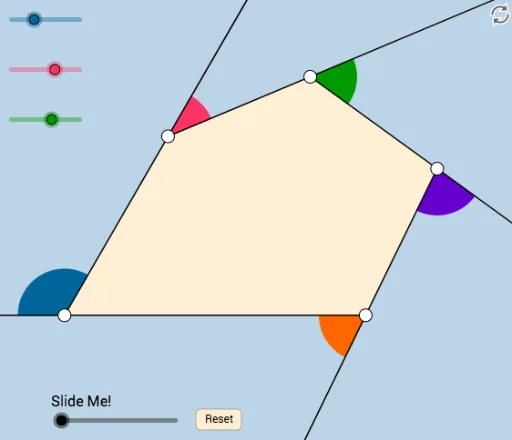
This example demonstrates the properties and calculation of exterior angles in a pentagon, covering core concepts like the sum of exterior angles theorem and the relationship between interior and exterior angles. It is constructed using GeoGebra commands such as Ray, Rotate, Angle, Point, Line, Circle, Intersect, Segment, and Polygon, making it suitable for middle school and above students to understand polygonal geometry and dynamic geometric transformations.
GeoGebra Commands & Parameters
Ray(A, B) → fRotate(A, α, B) → A'Angle(A, B, A') → βRay(B, A') → gPoint(g) → CLine(C, f) → hCircle(C, 2) → cIntersect(c, h) → D, EIntersect(c, g, 2) → FRay(C, A) → iAngle(B, C, A) → γRotate(B, δ, C) → B'Angle(B, C, B') → εRay(C, B') → jLine(A, g) → kIntersect(k, j) → HSegment(C, H) → lPoint(l) → GLine(G, g) → mLine(B, A) → nIntersect(m, n) → IAngle(C, G, I) → ζRotate(C, η, G) → C'Angle(C, G, C') → θ_1Ray(G, C') → pIntersect(n, p) → JSegment(G, J) → qPoint(q) → KRay(K, A) → rLine(C, G) → sLine(G, K) → tLine(K, A) → aLine(B, C) → bSegment(B, C) → dSegment(C, G) → eSegment(G, K) → f_1Segment(K, A) → g_1Segment(A, B) → h_1Min({d, e, f_1, g_1, h_1}) → oCircle(B, (0.3 * o)) → c_1Circle(C, (0.3 * o)) → d_1Circle(G, (0.3 * o)) → e_1Circle(K, (0.3 * o)) → k_1Circle(A, (0.3 * o)) → p_1Intersect(c_1, n) → L, MIntersect(c_1, b) → N, OIntersect(d_1, b) → P, QIntersect(d_1, s) → R, SIntersect(e_1, t) → T, UIntersect(e_1, s) → V, WIntersect(k_1, t) → Z, A_1Intersect(k_1, a) → B_1, C_1Intersect(p_1, n) → D_1, E_1Intersect(p_1, a) → F_1, G_1Line(G, A) → i_1CircleSector(B, O, L) → q_1CircleSector(C, S, Q) → r_1CircleSector(A, D_1, G_1) → c_2CircleSector(K, C_1, A_1) → t_1CircleSector(G, U, W) → s_1Polygon(B, A, K, G, C) → poly1, b_1, a_1, k_2, g_2, c_3Dilate(A, If[0 < u ≤ 1, 1 - u, 0], B) → A'_1Vector(A, A'_1) → vTranslate(c_2, v) → d_2Dilate(B, If[1 < u ≤ 2, 2 - u, 0], C) → B'_1Vector(B, B'_1) → wTranslate(q_1, w) → e_2Translate(d_2, w) → f_2Dilate(C, If[2 < u ≤ 3, 3 - u, 0], G) → C'_1Vector(C, C'_1) → u_1Translate(e_2, u_1) → h_2Translate(f_2, u_1) → p_2Translate(r_1, u_1) → q_2Dilate(G, If[3 < u ≤ 4, 4 - u, 0], K) → G'Vector(G, G') → v_1Translate(q_2, v_1) → r_2Translate(s_1, v_1) → s_2Translate(h_2, v_1) → t_2Translate(p_2, v_1) → d_3CircleArc(A, D_1, G_1) → e_3CircleArc(B, O, L) → f_3CircleArc(C, S, Q) → g_3CircleArc(G, U, W) → h_3