
Pedro's String Problem
Loading the math board and drawing, please wait…
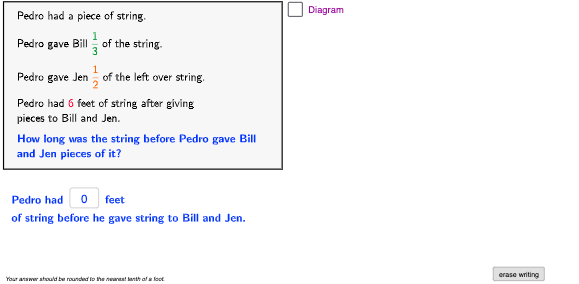
This example demonstrates a word problem about Pedro cutting and sharing a piece of string, using a tape diagram as a visual aid. It involves concepts like addition, division, fractions, and ratios. The construction summary utilizes GeoGebra commands and objects such as Segment, Textfield, Polygon, Point, Sequence, Object, and Defined to create and display the tape diagram and interactive elements. Suitable for elementary or middle school mathematics education, focusing on basic arithmetic and geometric visualization.
GeoGebra Commands & Parameters
Segment(AReference + (10 / a, 0), AReference + (10 / a, -3)) → diagBMasterPoleTextfield(answer) → ansFieldPolygon(AReference, AReference + (10, 0), AReference + (10, height), AReference + (0, height)) → diagAbox, diagBoxAbot, diagBoxAr, diagBoxAtop, diagBoxAlSegment(AReference + (10 / a, 0), AReference + (10 / a, height)) → diagAlinePoint(diagBMasterPole) → BReferencePolygon(BReference, BReference + (10 - 10 / a, 0), BReference + (10 - 10 / a, height), BReference + (0, height)) → diagBbox, diagBoxBbot, diagBoxBr, diagBoxBtop, diagBoxBLSegment(BReference + (0, height), AReference + (10 / a, 0)) → diagDotABLSegment(BReference + (10 - 10 / a, height), AReference + (10, 0)) → diagDotABRSegment(BReference + ((10 - 10 / a) / b, y(AReference) - y(BReference)), BReference + ((10 - 10 / a) / b, -3)) → diagCMasterPolePoint(diagCMasterPole) → CReferencePolygon(CReference, (x(AReference) + 10, y(CReference)), (x(AReference) + 10, y(CReference) + height), CReference + (0, height)) → diagCbox, diagBoxCbot, diagBoxCr, diagBoxCtop, diagBoxClSegment(BReference + ((10 - 10 / a) / b, 0), BReference + ((10 - 10 / a) / b, height)) → diagBlinePolygon(AReference, AReference + (10 / a, 0), AReference + (10 / a, height), AReference + (0, height)) → diagAgiven, amaster, k, m, nPolygon(BReference, BReference + ((10 - 10 / a) / b, 0), BReference + ((10 - 10 / a) / b, height), BReference + (0, height)) → diagBgiven, bmaster, p, q, rSequence(Segment[AReference + (k, 0), AReference + (k, height)], k, 0, x(AReference) + 9.9, 10 / a) → diagAdivSequence(Segment[BReference + (k, 0), BReference + (k, height)], k, 0, x(AReference) + 9.9, (10 - 10 / a) / b) → diagBdivPolygon(AReference + (10, -20), AReference + (20, -20), AReference + (20, 20), AReference + (10, 20)) → whiteCoverRt, l, s, t, a_1Segment(CReference + (0, height), (x(CReference), y(BReference))) → diagDotBCLSegment((x(AReference) + 10, y(CReference) + height), (x(AReference) + 10, y(BReference))) → diagDotBCRTextfield(a) → aFieldTextfield(b) → bFieldTextfield(c) → cFieldPolygon(fbPedroSpeechBubblePt + (-6.26, -0.15), fbPedroSpeechBubblePt + (-5, 0.95), fbPedroSpeechBubblePt + (-3.6, 0.95), fbPedroSpeechBubblePt + (-5.5, 0.95), fbPedroSpeechBubblePt + (-6.2, 1.3), fbPedroSpeechBubblePt + (-6.2, 3.5), fbPedroSpeechBubblePt + (-5.5, 3.85), fbPedroSpeechBubblePt + (-0.25, 3.85), fbPedroSpeechBubblePt + (0.5, 3.5), fbPedroSpeechBubblePt + (0.5, 1.3), fbPedroSpeechBubblePt + (-0.25, 0.95)) → fbPedroSpeechBubble, fbPedroSpeechBubbleSeg_3, fbPedroSpeechBubbleSeg_4, fbPedroSpeechBubbleSeg_6, fbPedroSpeechBubbleSeg_5, fbPedroSpeechBubbleSeg_7, fbPedroSpeechBubbleSeg_8, fbPedroSpeechBubbleSeg_9, fbPedroSpeechBubbleSeg_{10}, fbPedroSpeechBubbleSeg, fbPedroSpeechBubbleSeg_1, fbPedroSpeechBubbleSeg_2Object("stroke1") → fakeStrokeDefined(fakeStroke) → strokeExistsObject("text1") → fakeTextDefined(fakeText) → textExists