
Fraction Addition Estimation Practice
Loading the math board and drawing, please wait…
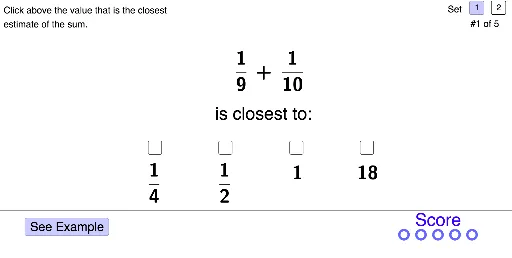
This example demonstrates how to estimate whether the sums of fraction addition problems are less than or more than a given number, with feedback and examples of estimation strategies provided. Core math concepts include fraction addition, inequality judgment, and mathematical estimation. Construction highlights use of GeoGebra commands like If, Polygon, FractionText, Ellipse, Vector, Segment, Sequence for creating problem interfaces, displaying results, and interactive feedback. Suitable for middle school and above mathematics education, fostering students' estimation skills and fraction operation understanding.
GeoGebra Commands & Parameters
If(set ≟ 1, Element[sumBenchmarkSet1, problem], Element[sumBenchmarkSet2, problem]) → sumBenchmarkValueIf(set ≟ 1, {0.25, 1, 0.5, 0.5, 8}, {0.25, 0.1111111111111111, 1, 0.5, 0.5}) → SR1If(set ≟ 1, {0.5, 2, 1, 1, 0.5}, {0.5, 0.25, 2, 1, 6}) → SR2If(set ≟ 1, {1, 19, 2, 8, 0.5}, {1, 0.5, 15, 2, 0.5}) → SR3If(set ≟ 1, {18, 21, 6, 16, 0.5}, {16, 1, 17, 8, 11}) → SR4If(set ≟ 1, {1, 2, 3, 2, 3}, {1, 4, 2, 3, 3}) → ansCorrectIf(Element[ansCorrect, problem] ≟ 1, (2, 1.8), If[Element[ansCorrect, problem] ≟ 2, (8, 1.8), If[Element[ansCorrect, problem] ≟ 3, (14, 1.8), (20.1, 1.8)]]) → SkipCorrectPtIf(ansSkip ≟ 1, SkipCorrectPt, If[sr1, (5.9, 1.9), If[sr2, (9.3, 1.9), If[sr3, (12.65, 1.9), If[sr4, (16, 1.9)]]]]) → AnsSelectedPtIf(sr1, SR1, If[sr2, SR2, If[sr3, SR3, SR4]]) → SRSelectPolygon(NextPt + (0, 0.2), NextPt + (0.2, 0), NextPt + (2, 0), NextPt + (2, -0.5), NextPt + (4, 0.5), NextPt + (2, 1.5), NextPt + (2, 1), NextPt + (0.2, 1), NextPt + (0, 0.8)) → nextPoly, nextPoly_2, nextPoly_3, nextPoly_4, nextPoly_5, nextPoly_6, nextPoly_7, nextPoly_8, nextPoly_9, nextPoly_{10}If(set ≟ 1, {1, 11, 3, 4, 3}, {1, 3, 4, 1, 4}) → term1numIf(set ≟ 1, {1, 8, 8, 4, 4}, {1, 4, 11, 7, 7}) → term2numIf(set ≟ 1, {9, 12, 4, 7, 4}, {7, 5, 5, 5, 9}) → term1denomIf(set ≟ 1, {10, 9, 7, 9, 7}, {9, 9, 12, 4, 8}) → term2denomFractionText(Element[SR1, problem]) → SR1textFractionText(Element[SR2, problem]) → SR2textFractionText(Element[SR3, problem]) → SR3textFractionText(Element[SR4, problem]) → SR4textIf(set ≟ 1, {0, 0, 0, 0, 5}, {0, 0, 0, 0, 3}) → term1mixedWholeIf(set ≟ 1, {0, 0, 0, 0, 3}, {0, 0, 0, 0, 2}) → term2mixedWholeIf(sr1, 1, If[sr2, 2, If[sr3, 3, If[sr4, 4, 0]]]) → srSelectIf(srSelect ≟ Element[ansCorrect, problem], 1, 0) → correctPolygon(AnsSelectedPt + If[Element[SRSelect, problem] < 1, (0, 0), (0, 0.8)], AnsSelectedPt + (2, 0) + If[Element[SRSelect, problem] < 1, (0, 0), (0, 0.8)], AnsSelectedPt + (2, 2.5), AnsSelectedPt + (0, 2.5)) → ansSelectedPoly, ansSelectedPoly_2, ansSelectedPolyR, ansSelectedPolyTop, ansSelectedPolyLIf(sr1 ∨ sr2 ∨ sr3 ∨ sr4, true, false) → ansSelectedIf(set ≟ 1, {0.125, 1, 1, 0.5, 6}, {0.125, 0.5, 1, 0.25, 3}) → term1BenchmarkIf(set ≟ 1, {0.125, 1, 1, 0.5, 3}, {0.125, 0.5, 1, 2, 3}) → term2BenchmarkFractionText(If[set ≟ 1, Element[sumBenchmarkSet1, problem], Element[sumBenchmarkSet2, problem]]) → sumBenchmarkIf(Element[ansCorrect, problem] ≟ 1, (6.9, 3.8), If[Element[ansCorrect, problem] ≟ 2, (10.25, 3.8), If[Element[ansCorrect, problem] ≟ 3, (13.65, 3.8), (17, 3.8)]]) → CorrectEllipsePt2Ellipse(CorrectEllipsePt1, CorrectEllipsePt2, CorrectEllipsePt3) → correctEllipseVector((14.5, 0.5), (13.7, 1)) → exCorrectArrowSegment((17.3, 8), (19.7, 8)) → exSegBenchmarkSegment((12.8, 8), (16.4, 8)) → exSegOriginalVector(CorrectEllipsePt2 + (1.9, 0), CorrectEllipsePt2 + (0.9, 0)) → ansNoteIncCorrVectorPolygon(AnsNotePolyPt + (0, If[sumBenchmarkValue ≥ 1, 0.5, 0]), AnsNotePolyPt + (6.75, If[sumBenchmarkValue ≥ 1, 0.5, 0]), AnsNotePolyPt + (6.75, 5), AnsNotePolyPt + (0, 5)) → ansNotePoly, f, g, h, iIf(set ≟ 1, {0, 0, 0, 0, 0}, {0, 0, 0, 0, 5}) → SR1mixedWholeIf(set ≟ 1, {0, 0, 0, 0, 8}, {0, 0, 0, 0, 0}) → SR2mixedWholeIf(set ≟ 1, {0, 0, 0, 0, 9}, {0, 0, 0, 0, 6}) → SR3mixedWholeIf(set ≟ 1, {0, 0, 0, 0, 10}, {0, 0, 0, 0, 0}) → SR4mixedWholeSequence((17.8 + i, 0.6), i, 1, 4.5, 0.81) → scorePtsEmptySequence((17.8 + i, 0.6), i, 1, scoreTotal, 0.81) → scorePts