
PDF and CDF of Random Triangle Area in a Unit Square
Loading the math board and drawing, please wait…
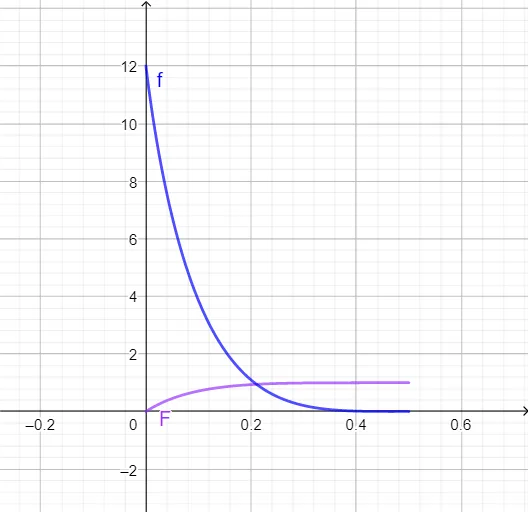
This example demonstrates the probability density function (PDF) and cumulative distribution function (CDF) of the area of a triangle formed by three uniformly random points inside a unit square. It covers geometric probability, random variables, PDF/CDF concepts, integration for area distribution, and coordinate geometry area formulas. Construction uses GeoGebra objects nu (random point coordinates), F (CDF), nu' (derivative/density), f (PDF), and xList/yList (coordinate lists) to generate random triangles and compute their area distribution. Suitable for high‑school probability/statistics electives, undergraduate probability courses, and as a visual aid for teaching geometric probability and function graphing.
GeoGebra Commands & Parameters
nu(x) = DataFunction[{0, 0, 0.0078125, 0.015625, 0.0234375, 0.03125, 0.0390625, 0.046875, 0.0546875, 0.0625, 0.0703125, 0.078125, 0.0859375, 0.09375, 0.1015625, 0.109375, 0.1171875, 0.125, 0.1328125,F(x) = ((4 * x / 3) * (10 - (17 * x))) - (((16 * x^(3) / 3) * (17 - (3 * ln((2 * x))))) * ln((2 * x))) + (((2 / 3 * (1 - (16 * x) - (68 * x^(2)))) * (1 - (2 * x))) * ln(1 - (2 * x))) + (((16 * x^(2))nu'(x) = If[x ≟ 0, 1, ((-ln(abs(1 - x)))) / x]f(x) = ((-4 / 3 * ((-68 * x^(2)) - (16 * x) + 1)) * ln((-2 * x) + 1)) - (((16 * x^(2)) * ((-3 * ln((2 * x))) + 17)) * ln((2 * x))) - ((16 / 3 * x^(3)) * ((-3 * ln((2 * x))) + 17) / x) + ((16 * x^(3)){0, 0, 0.0078125, 0.015625, 0.0234375, 0.03125, 0.0390625, 0.046875, 0.0546875, 0.0625, 0.0703125, 0.078125, 0.0859375, 0.09375, 0.1015625, 0.109375, 0.1171875, 0.125, 0.1328125, 0.140625, 0.1484375,{0, 0, 0.00782781200497013, 0.015686462774453968, 0.023576278759893383, 0.031497592290230116, 0.03945074172360803, 0.04743607160421935, 0.05545393282450461, 0.06350468279293822, 0.07158868560763756, 0
AI Drawing Prompt Reference
Within a unit square, randomly select three points to form a triangle, and plot the probability density function and cumulative distribution function of the triangle's area, demonstrating the probability distribution of random triangle areas. Start by drawing the coordinate axes and the unit square, then generate multiple random triangles and calculate their areas, finally plot the probability density function and cumulative distribution function curves for the area, ensuring they are within the unit square to reflect the relationship between geometric probability and function graphing.
The prompt above was compiled from the original drawing commands and is for reference only.