
Partial Derivative Visual: Tangent Planes and Directional Slopes on a Surface
Loading the math board and drawing, please wait…
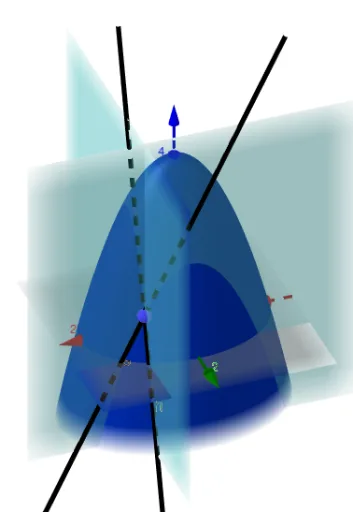
①This example demonstrates the geometric meaning of partial derivatives by showing a 3D surface with a movable point, where the slope along the x- and y-directions is visualized as tangent lines or a tangent plane.②Core mathematical concepts include partial derivatives, directional derivatives, tangent planes, limits, and multivariable calculus; the construction also references integers, natural numbers, conditional probability, and cosine, but the main focus is on differentiation.③Construction highlights: from the summary, objects a, f, b, A, g, h are used—likely f is a bivariate function surface, A is a point on the surface, g and h are curves or planes representing the partial derivative slices, and sliders or input fields control the point coordinates to update the displayed slopes.④This is suitable for university-level calculus or multivariable calculus courses, as well as advanced high school students or teacher demonstrations, helping learners connect abstract derivative formulas with visual 3D representations.
GeoGebra Commands & Parameters
x = 1z = 4 - x^(2) - (2 * y^(2))y = 1(1, 1, 1)Line3d g(None, None)Line3d h(None, None)
AI Drawing Prompt Reference
Draw a 3D surface with equation z=4-x^2-2y^2. Place a movable point on the surface, and show the tangent lines along the x and y directions, as well as the tangent plane at the point. Use sliders to control the coordinates of the point.
The prompt above was compiled from the original drawing commands and is for reference only.