
Parameterized Visualization of Cylinder and Cone Volume
Loading the math board and drawing, please wait…
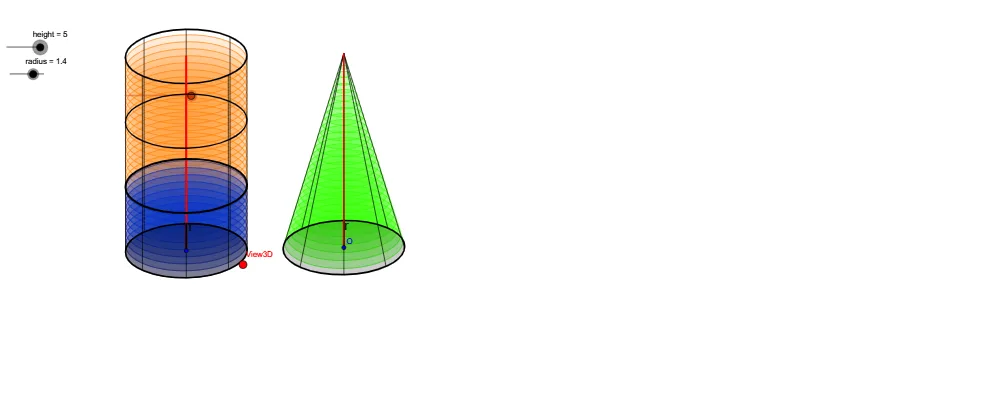
This example uses 3D geometric modeling and parameter-driven construction to visualize the volume relationship between a cylinder and a cone, especially under shared base-area and height conditions, and how the result changes as key parameters vary. It centers on cylinder and cone volume, parameterization with radius and height, and the idea of generating cross-sections/contours using trigonometric parameter variables (sin and cos). In GeoGebra, the build relies on View3D for spatial presentation, radius and height as the main parameters, and Vector plus Line/Segment to place geometry in the correct spatial directions. Trigonometric expressions such as sinphi, cosphi, sintheta, and costheta drive the positions of points (e.g., X, Y, Z and intermediate objects) around circular directions. Commands including Translate, Dilate, Mirror, Intersect, Midpoint, and OrthogonalLine handle alignment, symmetry, scaling, intersection computation, and perpendicular construction. Conic and Sequence support constructing relevant curves/surfaces and organizing the parameter sweep. Suitable for high school through early university, and useful for teaching solid geometry alongside parameterization and trigonometric-driven modeling.
GeoGebra Commands & Parameters
Vector(B_1, Y) → vVector(B_1, X) → wTranslate(O, Vector[(height * w)]) → CVector(B_1, Z) → uTranslate(O, Vector[(radius * u)]) → A_3OrthogonalLine(View3D, yAxis) → a_2OrthogonalLine(View3D, xAxis) → b_2Segment(O, A_3) → dTranslate(O, Vector[(radius * v)]) → BSegment(O, B) → eMirror(B, O) → DMirror(A_3, O) → ESegment(D, O) → h_1Segment(E, O) → iMidpoint(B, A_3) → FMidpoint(B, F) → GMidpoint(O, G) → HMidpoint(H, G) → IMirror(I, G) → JConic(A_3, J, B, E, D) → fSegment(C, A_3) → jSegment(C, B) → lSegment(C, E) → m_2Segment(C, D) → n_2Line(F, O) → pMidpoint(B, E) → KLine(K, O) → qIntersect(f, p) → L, MIntersect(f, q) → N, PSegment(C, N) → rSegment(C, L) → sSegment(C, P) → tSegment(C, M) → a1Segment(C, O) → b1Vector(O, H1) → zTranslate(f, z) → p1Translate(C, z) → I1Vector(H1, I1) → u1Translate(p1, u1) → q1Translate(D, z) → J1Translate(N, z) → K1Translate(A_3, z) → M1Translate(M, z) → N1Translate(L, z) → O1Translate(E, z) → P1Translate(P, z) → Q1Translate(B, z) → R1Translate(J1, u1) → S1Translate(K1, u1) → T1Translate(M1, u1) → U1Translate(N1, u1) → V1Translate(R1, u1) → W1Translate(Q1, u1) → Z1Translate(O1, u1) → A'2Translate(P1, u1) → B2Segment(S1, J1) → l1Segment(T1, K1) → m1Segment(U1, M1) → n1Segment(V1, N1) → r1Segment(W1, R1) → s1Segment(Z1, Q1) → t1Segment(B2, P1) → a2Segment(A'2, O1) → b2Segment(I1, H1) → g2Segment(H1, M1) → h2Sequence(Translate[p1, Vector[(i * u1)]], i, 0, 1, o) → L1Sequence(Dilate[f, i, C], i, 0, 1, o) → L2Midpoint(h2) → J_1Midpoint(d) → L_1Dilate(f, a, C) → f'_2Translate(p1, Vector[(a / 3 * u1)]) → p1'Translate(p1, Vector[(1 / 3 * u1)]) → p1'_1Translate(p1, Vector[(2 / 3 * u1)]) → p1'_2Sequence(Dilate[f, i, C], i, a, 1, o) → liste11Sequence(Translate[p1, Vector[(i * u1)]], i, 0, a / 3, o) → liste1
AI Drawing Prompt Reference
Draw a 3D cylinder and a cone sharing the same base radius and height, with the base centered at the origin. The cylinder's base is an ellipse defined by trigonometric parameterization, and the cone's apex is at the center of the cylinder's top face. Connect the apex to multiple points on the base circumference with line segments to form lateral edges. Add a parallel elliptical cross-section midway up the cylinder, and connect its points to the apex with segments, illustrating the volume relationship. The overall shape is symmetric, emphasizing the volume comparison between the cylinder and cone.
The prompt above was compiled from the original drawing commands and is for reference only.