
Parallelogram with Diagonals
Loading the math board and drawing, please wait…
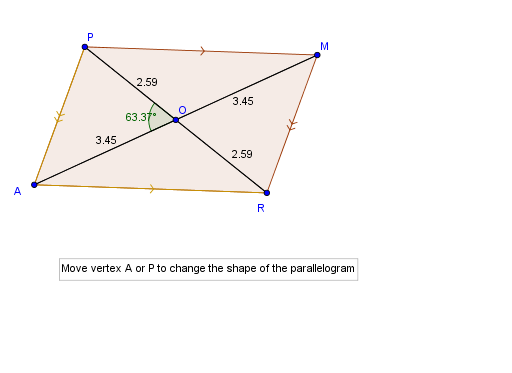
This example illustrates the properties of a parallelogram and its diagonals. Key mathematical concepts include the definition of a parallelogram and the properties of its diagonals. Using GeoGebra commands such as Mirror, Polygon, Segment, and Angle, a parallelogram and its diagonals can be constructed. Suitable for students at the middle school level and above to learn geometric construction and related properties.
GeoGebra Commands & Parameters
Mirror(A, O) → MMirror(P, O) → RPolygon(P, M, R, A) → poly1, b, c', b', cSegment(P, R) → PRSegment(M, A) → QSSegment(P, O) → aSegment(O, M) → dSegment(O, A) → eSegment(O, R) → fAngle(P, O, A) → αSegment(A, R) → gSegment(P, A) → h
AI Drawing Prompt Reference
Draw a parallelogram and its diagonals. Start by drawing two vertices P and A, then mirror P over point O to get R, and mirror A over O to get M. Use P, M, R, and A to form a quadrilateral, which is the parallelogram with diagonals PR and QS. Finally, draw line segments from point O to each vertex, and the angle α.
The prompt above was compiled from the original drawing commands and is for reference only.