
Isosceles Trapezoid with Diagonals
Loading the math board and drawing, please wait…
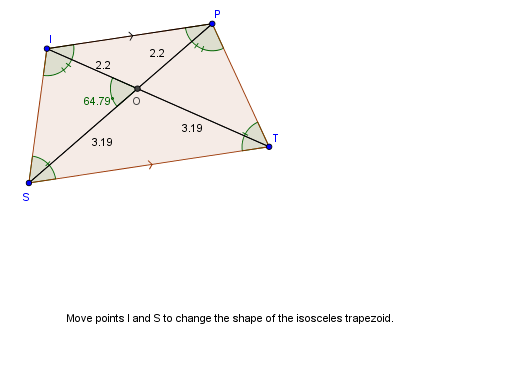
This example demonstrates the properties of an isosceles trapezoid and its diagonals. Key mathematical concepts include the definition of an isosceles trapezoid, properties of diagonals, and geometric construction. Using GeoGebra commands such as Line, Mirror, Polygon, Segment, and Intersect, the construction process is clearly illustrated. Suitable for middle school and above students or teachers.
GeoGebra Commands & Parameters
Line(A, B) → aMirror(I, a) → PMirror(S, a) → TPolygon(I, S, T, P) → poly1, c, d, d', c'Segment(I, T) → PSSegment(P, S) → ITIntersect(PS, IT) → OAngle(I, O, S) → αSegment(I, O) → bSegment(P, O) → eSegment(T, O) → fSegment(S, O) → gAngle(T, S, I) → βAngle(S, I, P) → γAngle(I, P, T) → δAngle(P, T, S) → εSegment(I, P) → h
AI Drawing Prompt Reference
Draw an isosceles trapezoid and its diagonals. Start by creating two parallel sides and the non-parallel sides to form the trapezoid. Use reflection to complete the shape. Then, find the intersection point of the diagonals and draw segments from this point to each side of the trapezoid. Label the angles formed. Finally, connect the endpoints of the diagonals and draw perpendicular lines from the vertices to the diagonals to highlight the symmetry and properties of the trapezoid's diagonals.
The prompt above was compiled from the original drawing commands and is for reference only.