
Parallelogram to Rectangle by jcohen
Loading the math board and drawing, please wait…
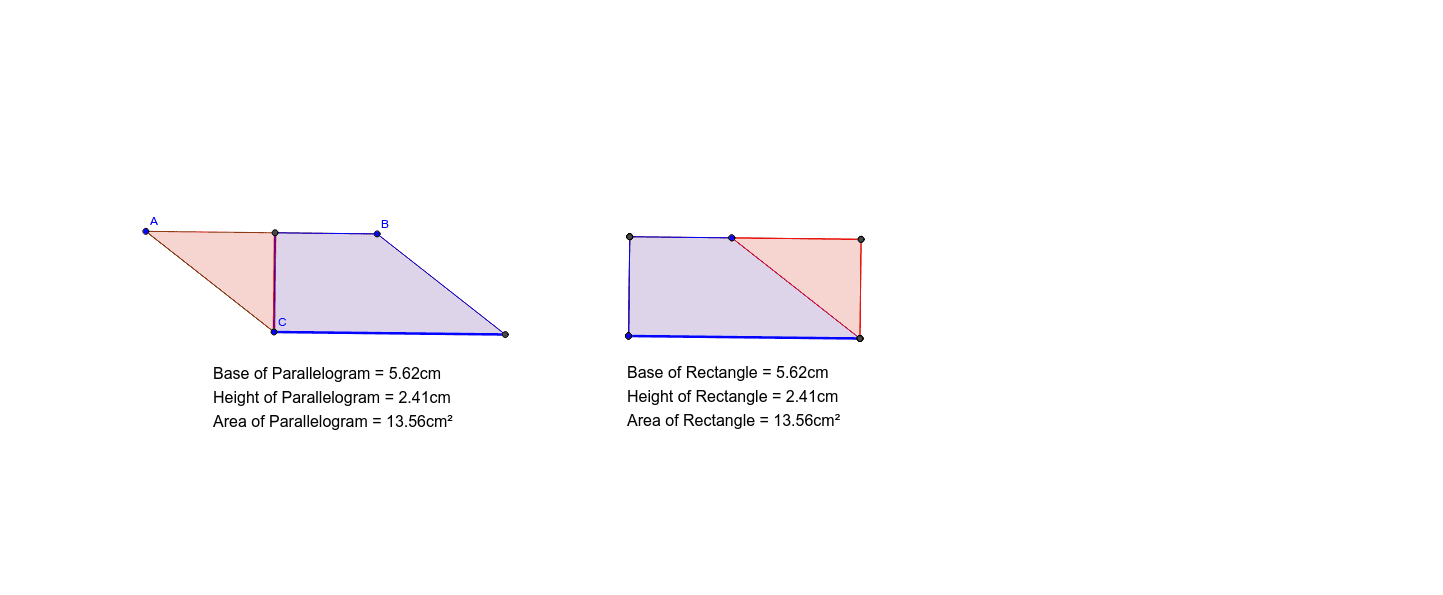
This example demonstrates how to transform a parallelogram into a rectangle through geometric transformations. Key mathematical concepts include symmetry and properties of rectangles. Using GeoGebra commands such as Line, OrthogonalLine, and Intersect, the construction of the parallelogram and its symmetric figures is illustrated. Suitable for middle and high school students to learn about geometric transformations and rectangle properties.
GeoGebra Commands & Parameters
Line(A, B) → aOrthogonalLine(C, a) → bIntersect(b, a) → DLine(C, a) → cSegment(C, A) → dLine(B, d) → eIntersect(e, c) → EPolygon(A, B, E, C) → poly1, a_1, b_1, e_1, c_1Segment(C, D) → fLine(F, f) → gMirror(C, g) → C'Mirror(D, g) → D'Segment(C', D') → f'Mirror(E, g) → E'Mirror(C, g) → C'_1Segment(E', C'_1) → hLine(E', f') → iIntersect(i, a) → GPolygon(E', G, D', C') → poly2, e', g_1, d', c'Polygon(D, B, E, C) → poly3, d_1, b_2, e_2, c_2Mirror(D, g) → D'_1Mirror(B, g) → B'Mirror(E, g) → E'_1Mirror(C, g) → C'_2Polygon(D'_1, B', E'_1, C'_2) → poly3', d'_1, b', e'_1, c'_2Polygon(A, D, C) → poly4, c_3, a_2, d_2Polygon(G, E', B') → poly5, b'_1, g_2, e'_2Mirror(E', f') → E''Mirror(G, f') → G'Mirror(D', f') → D''Mirror(C', f') → C''Polygon(E'', G', D'', C'') → poly2', e'', g', d'', c''Mirror(D'_1, f') → HMirror(B', f') → B''Mirror(E'_1, f') → IMirror(C'_2, f') → JPolygon(H, B'', I, J) → poly3'', h_1, b'', i_1, jMirror(G, f') → G'_1Mirror(E', f') → E''_1Mirror(B', f') → B''_1Polygon(G'_1, E''_1, B''_1) → poly5', b''_1, g'_1, e''_1Mirror(E', f') → E''_2Mirror(C'_1, f') → KSegment(E''_2, K) → h'
AI Drawing Prompt Reference
Draw a parallelogram and show how it transforms into a rectangle through symmetry. Start with a parallelogram, then drop a perpendicular from one vertex to the opposite side, marking the foot. Use this perpendicular as a mirror line to reflect the parallelogram's vertices, creating a symmetric copy. Then use another side as a mirror line to reflect some vertices again, producing multiple symmetric parallelograms and triangles. The final figure displays several mirrored quadrilaterals and triangles, illustrating that a parallelogram can become a rectangle via symmetry operations.
The prompt above was compiled from the original drawing commands and is for reference only.