
Circle to Parallelogram
Loading the math board and drawing, please wait…
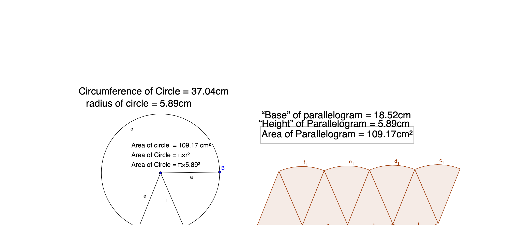
This example demonstrates how to transform a circle into a parallelogram using geometric constructions. Key mathematical concepts include properties of circles, definitions of parallelograms, and geometric transformations. Construction involves GeoGebra commands such as Circle, Segment, OrthogonalLine, Rotate, etc., to create objects like A, B, C, D. Suitable for middle or high school mathematics to understand geometric transformations and relationships.
GeoGebra Commands & Parameters
Circle(A, B) → cSegment(A, B) → aOrthogonalLine(B, a) → bOrthogonalLine(A, a) → dIntersect(c, d, 2) → CIntersect(c, d, 1) → DRotate(D, -22.5°, A) → D'_1Rotate(D, 22.5°, A) → D'Rotate(C, 15°, A) → C'Rotate(C, -15°, A) → C'_1Segment(A, D'_1) → eSegment(A, D') → fCircleArc(A, D'_1, D') → gMirror(g, b) → g'Mirror(A, b) → A'Mirror(D'_1, b) → ESegment(A', E) → e'Mirror(A, b) → A'_1Mirror(D', b) → D''Segment(A'_1, D'') → f'Mirror(D, b) → D'_2Vector(E, A') → uTranslate(g', u) → g''Translate(A', u) → A''Translate(E, u) → E'Segment(A'', E') → e''Translate(A'_1, u) → FTranslate(D'', u) → D'''Segment(F, D''') → f''Translate(D'_2, u) → GRotate(g'', -180°, A') → g'''Rotate(A'', -180°, A') → A'''Rotate(E', -180°, A') → E''Segment(A''', E'') → e'''Rotate(F, -180°, A') → F'Rotate(D''', -180°, A') → HSegment(F', H) → f'''Rotate(A'_1, -180°, A') → IRotate(G, -180°, A') → G'Line(H, b) → hMirror(g', h) → g''_1Mirror(g''', h) → kMirror(A', h) → A''_1Mirror(E, h) → E'_1Segment(A''_1, E'_1) → e''_1Mirror(A'_1, h) → JMirror(D'', h) → D'''_1Segment(J, D'''_1) → f''_1Mirror(A''', h) → KMirror(E'', h) → E'''Segment(K, E''') → iMirror(F', h) → F''Mirror(H, h) → H'Segment(F'', H') → jMirror(u, h) → u'Mirror(D'_2, h) → LMirror(E', h) → E''_1Mirror(I, h) → I'Line(D'''_1, h) → lMirror(g''_1, l) → pMirror(k, l) → k'Mirror(A''_1, l) → MMirror(E'_1, l) → NSegment(M, N) → mMirror(J, l) → J'Mirror(D'''_1, l) → OSegment(J', O) → nMirror(K, l) → K'Mirror(E''', l) → PSegment(K', P) → i'Mirror(F'', l) → F'''Mirror(H', l) → H''Segment(F''', H'') → j'Mirror(H, l) → H'_1Mirror(L, l) → L'Mirror(E''_1, l) → QMirror(I', l) → I''Vector(D''', A') → vTranslate(g'', v) → g'''_1Translate(A'', v) → A'''_1Translate(E', v) → E''_2Segment(A'''_1, E''_2) → e'''_1Translate(F, v) → F'_1Translate(D''', v) → RSegment(F'_1, R) → f'''_1Translate(A'_1, v) → STranslate(E'', v) → E'''_1Translate(I, v) → I'_1CircleSector(A', D'', E) → qCircleSector(H, E, E'_1) → rCircleSector(A''_1, E'_1, D'''_1) → sCircleSector(M, D'''_1, N) → tCircleSector(N, H'', M) → c_1CircleSector(D'''_1, M, A''_1) → d_1CircleSector(E'_1, A''_1, H) → e_1CircleSector(E, H, A') → f_1Area(c) → oPointIn(c) → Pointc_1Circumference(c) → circumferencecPointIn(c) → Pointc_2Circumference(c) → wPointIn(c) → Pointc
AI Drawing Prompt Reference
Start by drawing a circle with points A and B. Then, create two segments and their perpendicular lines, and find the intersection points C and D with the circle. Rotate points D and C around point A to generate new points and segments. Use mirroring and rotating operations to gradually form the four vertices and sides of a parallelogram.
The prompt above was compiled from the original drawing commands and is for reference only.