
Parallelogram Theorem 4 Demonstration
Loading the math board and drawing, please wait…
In collections
Parallelogram Lab
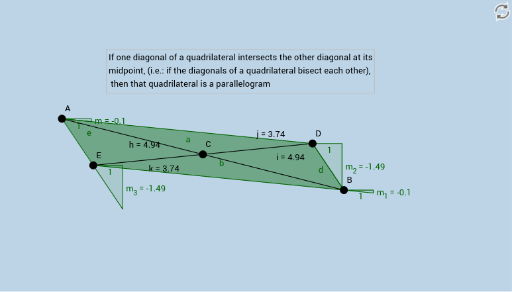
This example demonstrates the geometric construction and property verification of parallelogram-related theorems. It involves core mathematical concepts such as parallelograms, special points, stochastic processes, indefinite integrals, circles, differences, and slopes. The construction uses GeoGebra commands like Segment, Midpoint, Circle, Line, Intersect, Polygon, and Slope. Suitable for high school students and geometry enthusiasts to deeply understand parallelogram theorems and their applications.
GeoGebra Commands & Parameters
Segment(A, B) → fMidpoint(f) → CCircle(C, D) → cLine(C, D) → gIntersect(c, g, 2) → ESegment(A, C) → hSegment(B, C) → iSegment(D, C) → jSegment(E, C) → kPolygon(A, D, B, E) → poly1, a, d, b, eSlope(a) → mSlope(b) → m_1Slope(d) → m_2Slope(e) → m_3
AI Drawing Prompt Reference
Draw a parallelogram ABDE with points A, B, D, and E as vertices. First, draw line segment AB, then find its midpoint C, and draw a circle with C as the center. Draw a line g through C, and the second intersection of circle c and line g is point E. Next, draw line segments AC, BC, DC, and EC. Finally, use points A, D, B, and E to draw quadrilateral ABDE. Pay attention to the slopes of line segments AD and BE.
The prompt above was compiled from the original drawing commands and is for reference only.