
Altitudes and Orthocenters and Their Properties
Loading the math board and drawing, please wait…
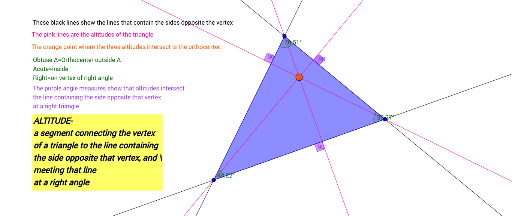
This example demonstrates the construction and properties of altitudes and orthocenters in a general quadrilateral, focusing on identifying rectangles. Key math concepts include orthocenters, rectangle properties, and coordinate geometry. GeoGebra commands like Polygon, Line, OrthogonalLine, Intersect, and Angle are used in the construction. Suitable for high school geometry education and geometric construction learning.
GeoGebra Commands & Parameters
Polygon(A, B, C) → poly1, c, a, bLine(A, C) → fLine(C, B) → gLine(B, A) → hOrthogonalLine(B, b) → iOrthogonalLine(C, c) → jOrthogonalLine(A, a) → kIntersect(i, j) → DAngle(B, A, C) → αAngle(A, C, B) → βAngle(C, B, A) → γAngle(b, i) → δAngle(k, a) → εAngle(j, c) → ζ
AI Drawing Prompt Reference
Draw a quadrilateral and construct perpendiculars from each vertex to the opposite sides to find the feet of the altitudes, forming a triangle with these feet. This triangle is the orthic triangle. Measure and label the interior angles of both the quadrilateral and the orthic triangle, focusing on the relationships between them and highlighting any rectangles that may exist within the quadrilateral.
The prompt above was compiled from the original drawing commands and is for reference only.