
Parallelogram Properties Exploration by Kim Kembitzky
Loading the math board and drawing, please wait…
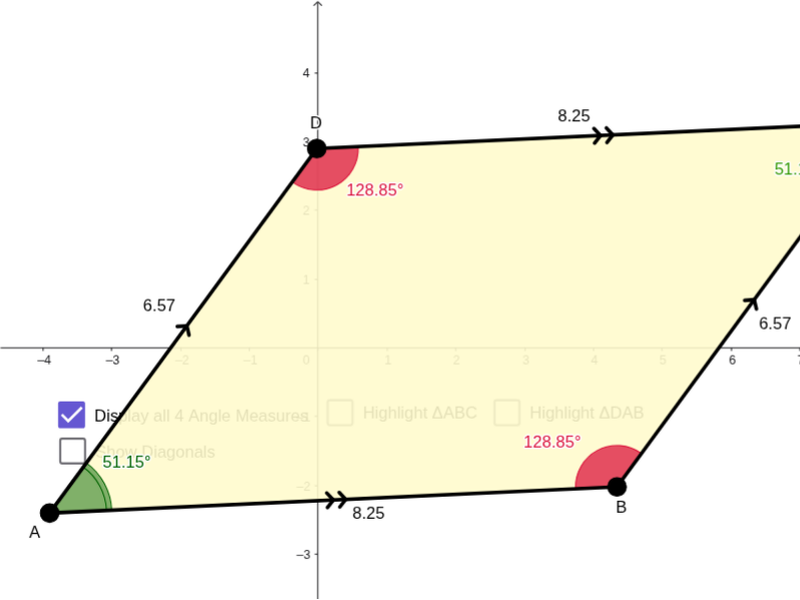
This example demonstrates the geometric properties of a parallelogram, including equal opposite sides, equal opposite angles, and bisecting diagonals. It uses GeoGebra commands like Segment, Line, Intersect, Midpoint, Angle, Polygon, and Mirror to construct and verify these properties. Suitable for middle school and above students to visually understand parallelogram characteristics and assist geometry teaching.
GeoGebra Commands & Parameters
Segment(A, B) → aSegment(A, D) → bLine(D, a) → cLine(B, b) → dIntersect(c, d) → CSegment(D, C) → eSegment(B, C) → fMidpoint(A, C) → ESegment(A, E) → gSegment(E, C) → hSegment(D, E) → iSegment(E, B) → jAngle(B, A, E) → αAngle(D, C, E) → βAngle(E, A, D) → γAngle(C, B, E) → δAngle(A, D, E) → εAngle(E, B, A) → ζAngle(E, D, C) → ηAngle(E, C, B) → θAngle(C, E, D) → ιPolygon(A, B, C) → poly1, c_1, a_1, b_1Mirror(A, g) → A'Mirror(B, g) → B'Mirror(C, g) → C'Polygon(A', B', C') → poly1', c', a', b'Polygon(A, B, D) → poly2, d_1, a_2, b_2Mirror(A, j) → A'_1Mirror(B, j) → B'_1Mirror(D, j) → D'Polygon(A'_1, B'_1, D') → poly2', d', a'_1, b'_1Angle(B, A, D) → κAngle(A, D, C) → λAngle(D, C, B) → μAngle(C, B, A) → νPolygon(A, B, C, D) → poly3, a_3, b_3, c_2, d_2