
Area of Rhombus using Diagonals Investigation
Loading the math board and drawing, please wait…
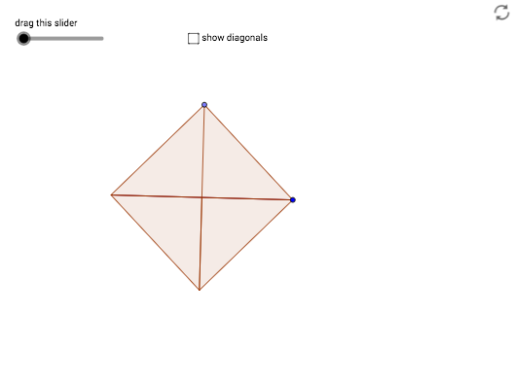
This example demonstrates how to calculate the area of a rhombus using its diagonals. Key math concepts include rhombus properties, perpendicular bisectors of diagonals, and the area formula (area = product of diagonals / 2). GeoGebra commands/objects used: Segment, LineBisector, Intersect, Point, Circle, Polygon, Vector, Translate, Line, OrthogonalLine, Mirror. Suitable for middle school and above students learning rhombus area calculation and geometric constructions.
GeoGebra Commands & Parameters
Segment(A, B) → aLineBisector(a) → bIntersect(b, a) → CPoint(b) → DCircle(C, D) → cIntersect(c, b, 2) → EPolygon(A, C, E) → poly2, e_1, a_2, c_1Polygon(C, B, E) → poly3, e_2, c_2, b_2Polygon(D, A, B) → poly1, b_1, d, a_1Vector(A, ((r * x(D)), (r * y(D)))) → uTranslate(A, u) → A'Translate(C, u) → C'_1Translate(E, u) → E'_1Polygon(A', C'_1, E'_1) → poly2', e', a', c'Line(D, B) → eTranslate(B, u) → B'_1Vector(B, B'_1) → vOrthogonalLine(B, d) → fMirror(B'_1, f) → B''Vector(B, B'') → wTranslate(C, w) → C'Translate(B, w) → B'Translate(E, w) → E'Polygon(C', B', E') → poly3', e'_1, c'_1, b'Segment(D, C) → gOrthogonalLine(F, b') → hCircle(F, (0.1 * b')) → kIntersect(k, h) → G, HLine(H, b') → iCircle(H, (0.5 * b')) → pIntersect(p, i) → I, JVector(H, J) → zVector(H, I) → jCircle(D, (0.1 * b')) → qIntersect(q, b) → K, LLine(L, e') → lCircle(L, e') → sIntersect(s, l) → M, NVector(L, M) → mVector(L, N) → nIntersect(a_1, b_1) → OIntersect(c', a') → PPoint(a) → QIntersect(a, a_1) → RSegment(Q, R) → d_1Line(A, B) → f_1Line(D, f_1) → g_1Translate(D, w) → D'OrthogonalLine(E', g_1) → h_1Intersect(g_1, h_1) → TSegment(T, E') → t
AI Drawing Prompt Reference
Draw a rhombus and demonstrate how to calculate its area using its diagonals. Start by drawing two intersecting diagonals and finding their intersection point and perpendicular bisectors. Use the intersection point as the center and the points on the perpendicular bisectors as radii to draw circles, which intersect at points forming the rhombus. Then, create auxiliary shapes using vector translations and reflections, and draw relevant lines and circles. Finally, verify the area formula (product of diagonals divided by two) through geometric relationships.
The prompt above was compiled from the original drawing commands and is for reference only.