
Parallelogram Law of Vector Addition
Loading the math board and drawing, please wait…
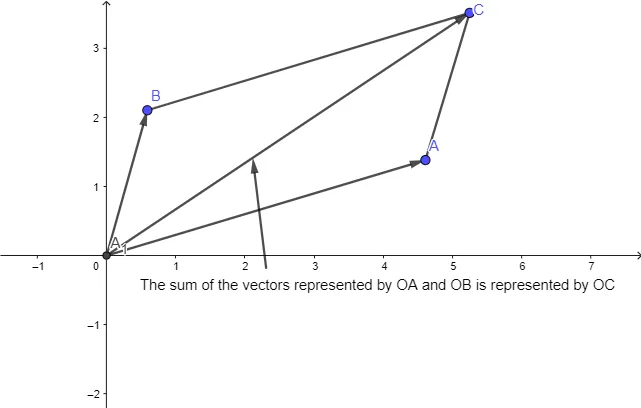
This GeoGebra example visually demonstrates the parallelogram law of vector addition, showing how the sum of two vectors corresponds to the diagonal of a parallelogram constructed from the original vectors. Core mathematical concepts include vector addition, the parallelogram law, coordinate geometry, and geometric transformations. The construction employs GeoGebra commands such as Intersect, Vector, Segment, and Point, using points, vectors, and line segments to build the parallelogram and mark the resultant vector. It is suitable for high school mathematics vector units, physics vector operation lessons, and as a geometric intuition aid for understanding vector summation.
GeoGebra Commands & Parameters
Intersect(xAxis, yAxis) → A_1Vector(A_1, A) → uVector(A_1, B) → vSegment(B, C) → fSegment(C, A) → gVector(A_1, C) → wPoint(w) → EVector(D, E) → a
AI Drawing Prompt Reference
Draw a parallelogram with points A and B as the starting points of two vectors. Draw vector u from A and vector v from B, with their endpoints at C and D respectively. Connect B to C and C to A to form the parallelogram ABCD. Draw vector w from A to D, and its endpoint E is the sum of vector u. Finally, draw vector a from D to E to represent the resultant vector of u and v.
The prompt above was compiled from the original drawing commands and is for reference only.