
Parallelogram Construction and Properties by Murat
Loading the math board and drawing, please wait…
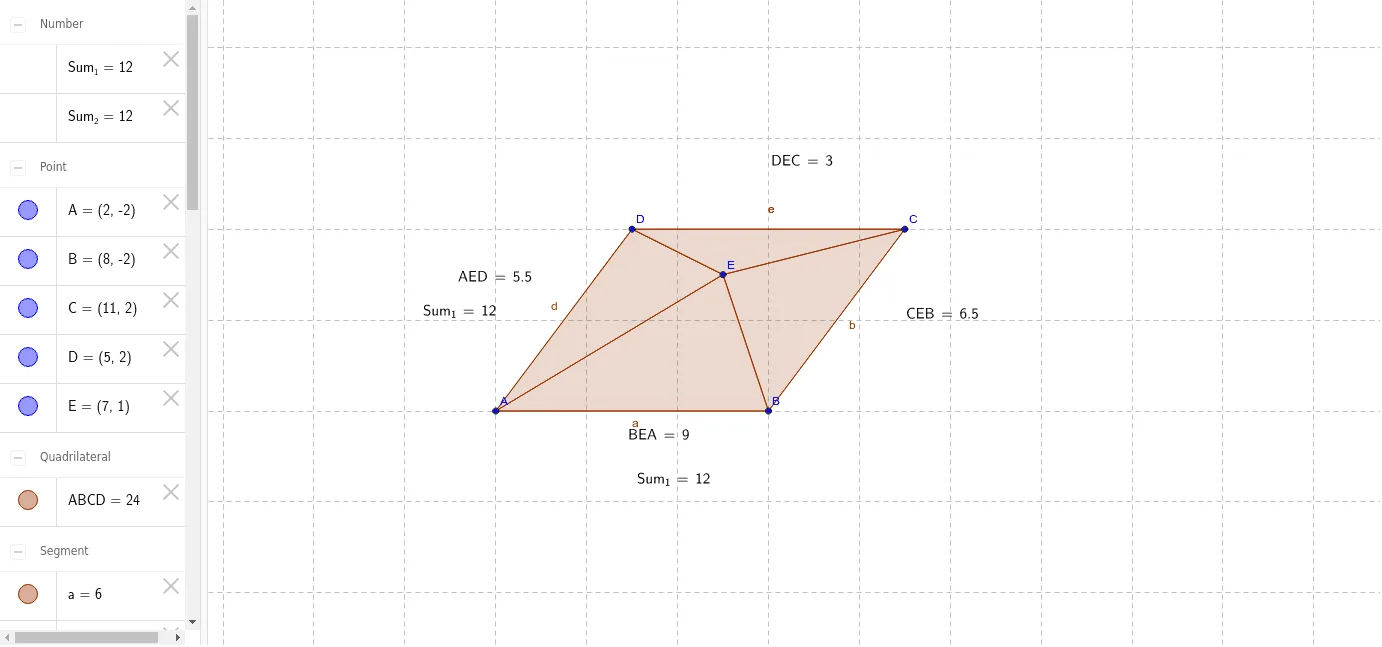
This example demonstrates the construction and properties of a parallelogram. The key mathematical concepts include the definition of a parallelogram, vector operations, and geometric construction. The construction involves GeoGebra commands such as Polygon, LaTeX, A, B, C, D, a, b, c, d, etc., to create parallelogram ABCD and perform vector operations. It is suitable for middle or high school mathematics learning to understand basic geometric properties and construction techniques.
GeoGebra Commands & Parameters
Polygon(A, B, C, D) → ABCD, a, b, c, dPolygon(D, E, C) → DEC, c_1, d_1, ePolygon(C, E, B) → CEB, b_1, c_2, e_1Polygon(B, E, A) → BEA, a_1, b_2, e_2Polygon(A, E, D) → AED, d_2, a_2, e_3LaTeX(AED, true, true) → text1LaTeX(BEA, true, true) → text2LaTeX(CEB, true, true) → text3LaTeX(DEC, true, true) → text4LaTeX(Sum_1, true, true) → text5LaTeX(Sum_1, true, true) → text6
AI Drawing Prompt Reference
Draw a parallelogram ABCD. The construction order is to first draw points A, B, C, and D, then connect them to form the parallelogram. Next, draw line segments from A to E, from B to E, from C to E, and from D to E. Finally, label these line segments and regions to help understand the properties and construction of the parallelogram.
The prompt above was compiled from the original drawing commands and is for reference only.