
Parallelogram Construction by Murat
Loading the math board and drawing, please wait…
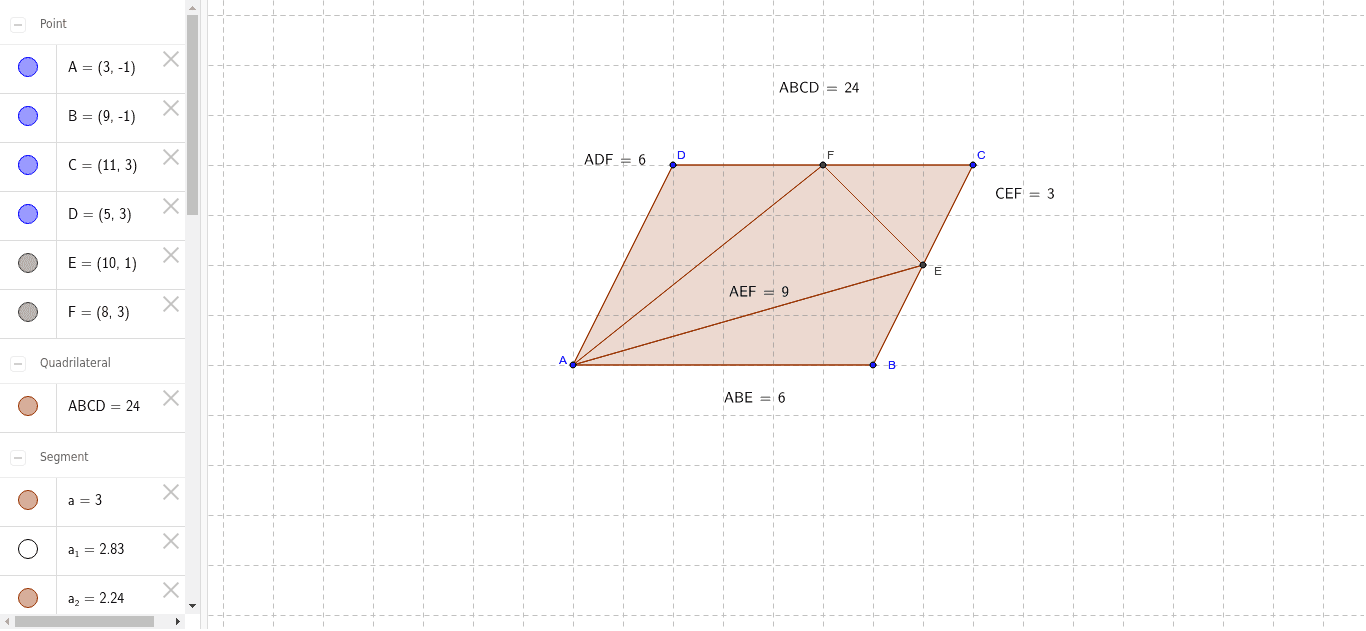
This example demonstrates the geometric construction and properties of a parallelogram. It involves core math concepts like polygons, vectors, coordinate geometry, and geometric construction. Key GeoGebra commands used include Polygon, Midpoint, and LaTeX, with objects like A, B, C, D, ABCD, vectors a, b, c, d. Suitable for high school mathematics teaching or geometric construction learning.
GeoGebra Commands & Parameters
Polygon(A, B, C, D) → ABCD, a_4, b, c, dMidpoint(B, C) → EMidpoint(D, C) → FPolygon(A, E, F) → AEF, f, a_1, eLaTeX(AEF, true, true) → AEF_1Polygon(F, E, C) → CEF, c_1, f_1, aLaTeX(ABCD, true, true) → text1LaTeX(CEF, true, true) → text2Polygon(A, B, E) → ABE, e_2, a_2, b_1Polygon(A, F, D) → ADF, d_1, a_3, f_2LaTeX(ABE, true, true) → text3LaTeX(ADF, true, true) → text4
AI Drawing Prompt Reference
Draw a parallelogram. Start with point A, then connect points B and C to form sides AB and BC. Next, connect points D and C to form sides CD and AD. Ensure that AB is parallel to CD and BC is parallel to AD. Finally, draw the parallelogram ABCD and mark the midpoints E and F.
The prompt above was compiled from the original drawing commands and is for reference only.