
Parallel Segments: Longer or Shorter?
Loading the math board and drawing, please wait…
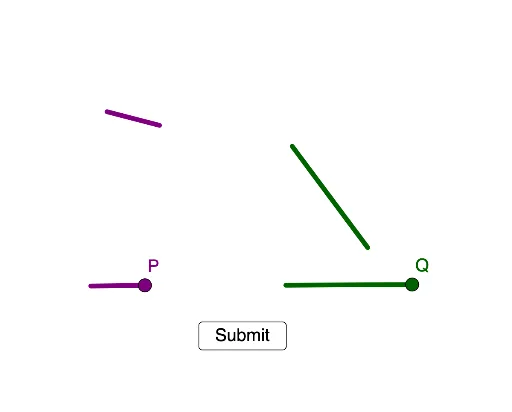
This example explores the ease of matching the slope of a shorter segment versus a longer segment. It involves the concept of slope and demonstrates construction using GeoGebra commands such as Polygon, RandomPointIn, Segment, Circle, Point, etc. Suitable for middle school and above students or teachers.
GeoGebra Commands & Parameters
Polygon(E, F, 4) → poly1, f, g, h, i, G, HPolygon(I, J, 4) → poly2, j, k, l, m, K, LRandomPointIn(poly2) → ARandomPointIn(poly1) → BSegment(A, A + ((3 * cos(aa)), (3 * sin(aa)))) → nSegment(B, B + ((7 * cos(bb)), (7 * sin(bb)))) → pCircle(C, 3) → cCircle(D, 7) → dPoint(d) → QSegment(D, Q) → qPoint(c) → PSegment(C, P) → r
AI Drawing Prompt Reference
Draw two squares, select a random point inside each square, draw parallel line segments from these points with lengths of 3 and 7, respectively. Then, draw circles with radii of 3 and 7, connect the center of each circle to the nearest point on the circle, and finally connect the centers of the two squares to demonstrate the relationship between parallel segments of different lengths and the circles.
The prompt above was compiled from the original drawing commands and is for reference only.