
Parallel Lines Coordinate Geometry Demo
Loading the math board and drawing, please wait…
In collections
A1.ACE.1 - Create and solve equations and inequalities
Expressing Geometric Properties with Equations (GPE) Cluster
Slope
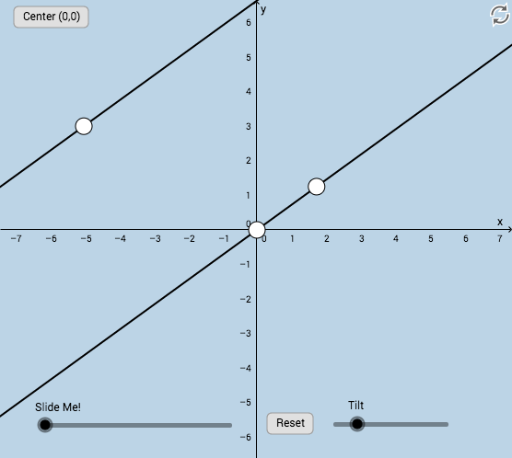
This example demonstrates the immediate relationships of parallel lines in the coordinate plane (dynamic illustration). It involves core math concepts like coordinate geometry, line equations, angles, triangles, and vector transformations. Construction highlights include commands like Rotate, Angle, Ray, Line, Point, Circle, Intersect, Segment, Min, CircleSector, Polygon, Dilate, Vector, and Translate. Suitable for high school mathematics teaching to understand properties of parallel lines and vector transformation applications.
GeoGebra Commands & Parameters
Rotate(B, (a * π / 180), A) → B'Angle(B, A, B') → αRay(A, B') → gLine(A, B') → hPoint(h) → CRay(B', C) → iPoint(i) → DLine(E, h) → jCircle(D, b) → cIntersect(c, k, 2) → FIntersect(h, l) → GSegment(G, F) → mSegment(F, D) → nMin(m, n) → dCircle(F, (0.3 * d)) → eIntersect(e, k, 2) → HIntersect(e, m, 1) → ICircleSector(F, H, I) → pPolygon(D, F, G) → poly1, g_1, d_1, f_1CircleSector(F, I, H) → qRay(F, H) → tDilate(G, If[0 < o ≤ 1, 1 - o, 0], F) → G'Segment(G, G') → rDilate(F, If[1 < o ≤ 2, 2 - o, 0], D) → F'Segment(F, F') → sRotate(p, If[2 < o ≤ 3, ((o - 2) * π / 2), π / 2], F) → p'Rotate(q, If[2 < o ≤ 3, ((-(o - 2)) * π / 2), ((-π)) / 2], F) → q'Dilate(D, If[3 < o ≤ 4, 4 - o, 0], E) → D'Vector(D, D') → uTranslate(D, u) → D'_1Translate(F, u) → F'_1Translate(G, u) → G'_1Polygon(D'_1, F'_1, G'_1) → poly1', g'_1, d'_1, f'_1Translate(G, u) → G'_2Translate(G', u) → G''Segment(G'_2, G'') → r'Translate(F, u) → F'_2Translate(F', u) → F''Segment(F'_2, F'') → s'Translate(p', u) → p''Segment(D'_1, G'_1) → h_1Translate(q', u) → q''
AI Drawing Prompt Reference
Draw two parallel lines in the coordinate plane to demonstrate their relationships. Start by rotating a point to create an angle, then use this angle to draw rays and lines. Find the intersections of the lines and use these points to draw circles, triangles, and sectors. Finally, apply dilation and translation to show the transformation of parallel lines and vectors, creating a dynamic geometric illustration.
The prompt above was compiled from the original drawing commands and is for reference only.