
Parabola: Reflective Property and Distance
Loading the math board and drawing, please wait…
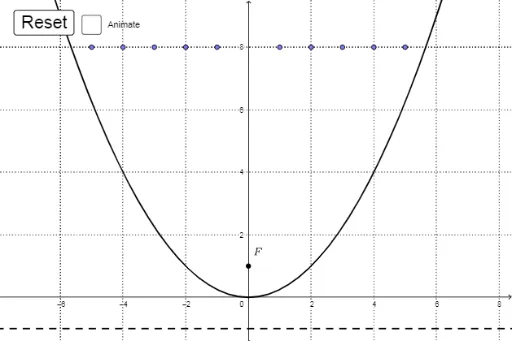
①This example dynamically demonstrates the reflective property of a parabola: rays emanating from the focus reflect off the parabola parallel to the axis, and it also shows that the distance from any point on the parabola to the focus equals its distance to the directrix. ②Core mathematical concepts include the definition of a parabola (locus of points equidistant from a fixed point and a fixed line), focus, directrix, law of reflection, and geometric distance relationships. ③Construction highlights: using GeoGebra commands such as Sequence to generate a series of points, Point to mark the focus and points on the directrix, and Segment to connect the focus, points on the parabola, and reflected paths; auxiliary points (A, B, C, etc.) and segments (l1, l2, g, h, etc.) are constructed to visualize the reflection path and the constant distance property. ④Suitable for high school analytic geometry or introductory college geometry courses, this example helps students intuitively grasp the optical property of parabolas and the distance equality theorem, and can be used for mathematical experiments or inquiry-based learning.
GeoGebra Commands & Parameters
Sequence((k, 8), k, -5, 5) → l1Sequence((k, (k^(2) / 4 * p)), k, -5, 5) → l2Point(l1) → APoint(l2) → BSegment(A, B) → gPoint(l2) → CPoint(l1) → DSegment(D, C) → hPoint(l1) → EPoint(l2) → GSegment(E, G) → iPoint(l2) → HPoint(l1) → ISegment(I, H) → jPoint(l1) → JPoint(l2) → KSegment(J, K) → kPoint(l2) → LPoint(l1) → MSegment(M, L) → lPoint(l2) → NPoint(l1) → OSegment(O, N) → mPoint(l2) → PPoint(l1) → QSegment(Q, P) → nPoint(l2) → RPoint(l1) → SSegment(S, R) → qPoint(l2) → TPoint(l1) → USegment(U, T) → rPoint(g) → VPoint(h) → WPoint(i) → ZPoint(j) → A_1Point(k) → B_1Point(l) → C_1Point(m) → D_1Point(n) → E_1Point(q) → F_1Point(r) → G_1Segment(B, F) → sSegment(C, F) → tSegment(G, F) → aSegment(H, F) → bSegment(K, F) → cSegment(L, F) → dSegment(N, F) → eSegment(P, F) → f_1Segment(R, F) → g_1Segment(T, F) → h_1Point(s) → H_1Point(t) → I_1Point(a) → J_1Point(b) → K_1Point(c) → L_1Point(d) → M_1Point(e) → N_1Point(f_1) → O_1Point(g_1) → P_1Point(h_1) → Q_1
AI Drawing Prompt Reference
Draw an upward-opening parabola with its focus above the origin and a horizontal directrix. Generate a series of points on the parabola and corresponding points on the directrix, connecting each pair with vertical line segments. From the focus, draw line segments to multiple points on the parabola, and from those points draw perpendicular segments to the directrix, illustrating the reflection paths. Additionally, select several points on the parabola and connect them to the focus and to their corresponding points on the directrix, visually demonstrating that distances from any point on the parabola to the focus and to the directrix are equal. The overall figure should clearly show the reflective property and the equal-distance relationship of the parabola.
The prompt above was compiled from the original drawing commands and is for reference only.