
Parabola Reflection Property
Loading the math board and drawing, please wait…
In collections
Conics Doug Kuhlmann
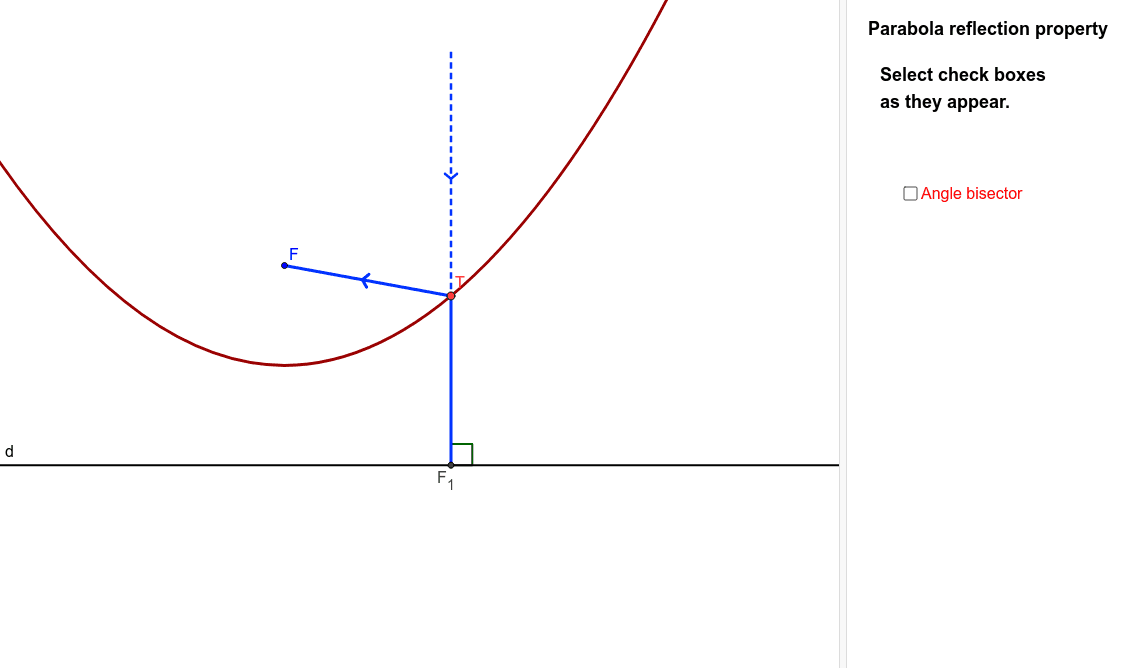
This example demonstrates the reflection property of a parabola. Key mathematical concepts include parabolas, vectors, and angles. Using GeoGebra commands such as Parabola, Point, OrthogonalLine, Intersect, etc., a dynamic demonstration of the parabola's reflection property is constructed. Suitable for high school mathematics education and learning.
GeoGebra Commands & Parameters
Parabola(F, d) → cPoint(c) → TOrthogonalLine(T, d) → d_1Intersect(d, d_1) → F_1Segment(F_1, T) → eAngularBisector(F, T, F_1) → aPoint(a) → POrthogonalLine(P, d) → gIntersect(d, g) → ASegment(P, A) → hSegment(P, F_1) → iSegment(P, F) → jPoint(a) → BPoint(a) → CPoint(d_1) → DAngle(C, T, D) → αAngle(F, T, B) → βAngle(B, T, F_1) → γSegment(D, T) → lSegment(T, F) → bAngle(P, A, F_1) → δAngle(F_1, A, P) → εAngle(d, e) → ζ
AI Drawing Prompt Reference
Draw a dynamic demonstration of a parabola's reflection property. First, draw a line d, then draw a parabola c with d as the focus. Take a point T on the parabola and draw a perpendicular line d_1 from T to d, with their intersection point F_1. Connect F_1 and T to form segment e, and draw the angle bisector a of ∠F_1Tc. Take a point P on a, draw a perpendicular line g from P to d, and let their intersection point be A. Connect P and A to form segment h. Connect P and F_1 to form segment i, and connect P and the focus F to form segment j. Take points B and C on the angle bisector a, and take point D on d_1. Connect D and T to form segment l, and connect T and the focus F to form segment b. Finally, measure the angles ∠PAB, ∠F_1TA, and the angle between d and e.
The prompt above was compiled from the original drawing commands and is for reference only.