
Pappus Area Theorem (I): Area Relations on an Arbitrary Quadrilateral
Loading the math board and drawing, please wait…
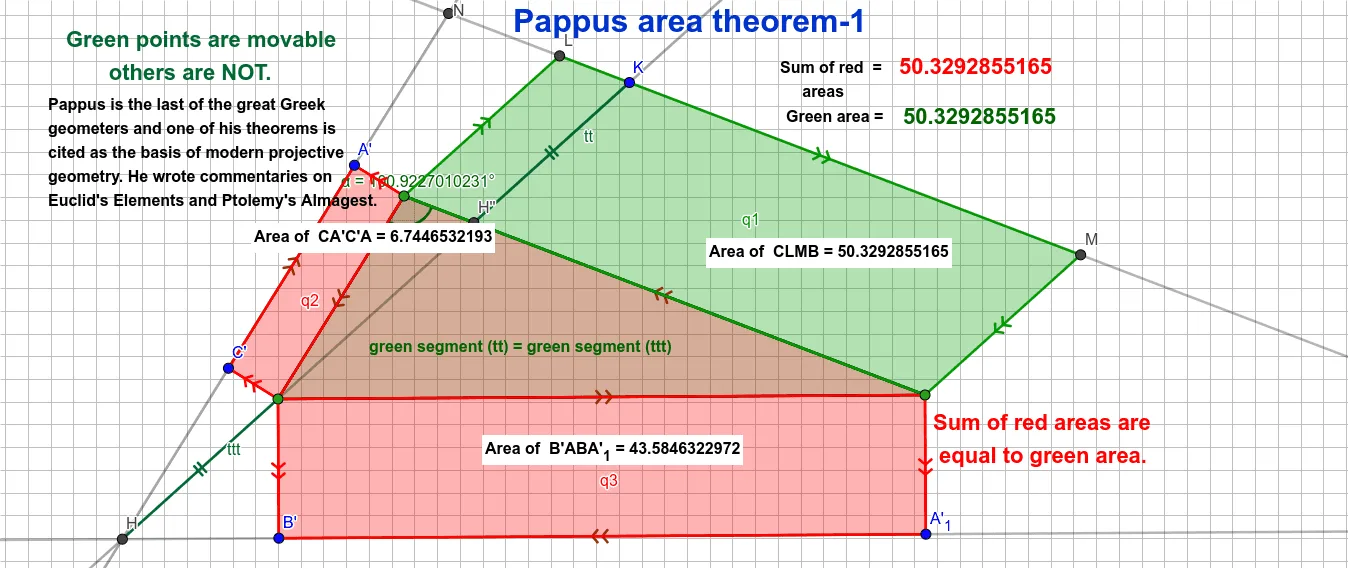
This GeoGebra example demonstrates the first case of Pappus's area theorem: given an arbitrary quadrilateral, construct parallelograms outward on two opposite sides, then connect corresponding vertices; the resulting figure's area relates to the original quadrilateral in a specific way. Core mathematical concepts include area conservation, properties of parallelograms, geometric transformations (translation, rotation, reflection), and polygon area computation. Construction highlights: using GeoGebra commands such as Polygon, LineBisector, Mirror, Intersect, Midpoint, PointIn, and Angle to build auxiliary lines, symmetric points, and intersections, while verifying angle and area relationships dynamically. Suitable for high school and above, this example serves as an interactive visual proof for classroom demonstrations or student-led exploration of geometric theorems.
GeoGebra Commands & Parameters
Polygon(A, B, C) → t1, c, a, bSegment(A, C) → fSegment(A, B) → gSegment(C, B) → hLineBisector(A, B) → iLineBisector(A, C) → jPoint(i) → DPoint(j) → EPoint(j) → FPoint(i) → GLine(F, b) → kLine(G, c) → lMirror(A, G) → A'_{1}Mirror(B, G) → B'Segment(A'_{1}, B') → c'Mirror(C, F) → C'Mirror(A, F) → A'Segment(C', A') → b'Segment(A, B') → mSegment(B, A'_{1}) → nSegment(A, C') → pSegment(C, A') → qLine(A', C') → rLine(B', A'_{1}) → sIntersect(r, s) → HSegment(A, H) → tttLine(H, A) → dLine(C, d) → eLine(B, d) → f_1Intersect(d, a) → IMidpoint(I, H) → JMirror(A, J) → A'_{2}Mirror(H, J) → H'Segment(A'_{2}, H') → t'Mirror(A'_{2}, I) → KMirror(H', I) → H''Segment(K, H'') → ttLine(K, a) → tIntersect(e, t) → LIntersect(f_1, t) → MPolygon(C, L, M, B) → q1, c_1, l_1, m_1, b_1Polygon(C, A', C', A) → q2, c_2, a', g_1, a_1Polygon(B', A, B, A'_{1}) → q3, h_1, a_2, b_2, a'_{1}PointIn(q1) → Pointq1PointIn(q2) → Pointq2PointIn(q3) → Pointq3Intersect(r, t) → NIntersect(s, t) → OAngle(A, C, B) → α
AI Drawing Prompt Reference
Draw an arbitrary quadrilateral and construct parallelograms outward on two opposite sides. Connect corresponding vertices to form a new figure, demonstrating the area relationship between the new figure and the original quadrilateral. Dynamically verify properties of parallelograms, symmetric points, angle bisectors, and reflections through geometric transformations. Include auxiliary lines, intersections, and midpoints, with polygon area calculations and angle relationships to illustrate a geometric proof.
The prompt above was compiled from the original drawing commands and is for reference only.