
Paper Folding Cubic Equations
Loading the math board and drawing, please wait…
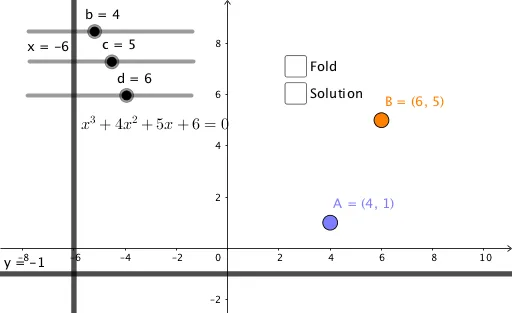
This example demonstrates the geometric interpretation of cubic equations through paper folding, integrating abstract algebraic concepts with tangible geometric manipulations. It involves core mathematical ideas such as equations, logarithmic functions, integers, median lines, hypergeometric distributions, and circumcircles. The construction utilizes GeoGebra commands and objects like Point, LineBisector, Mirror, Intersect, OrthogonalLine, Segment, Slope, and entities b, c, d, A, B, f, g, A', h, B', C, i, D, j, E, F, k, G, H, I, l, m, m_1, text1, a, e, text2. Suitable for high school and advanced learners to explore geometric solutions and spatial reasoning.
GeoGebra Commands & Parameters
Point(f) → A'LineBisector(A, A') → hMirror(B, h) → B'Intersect(h, yAxis) → CIntersect(h, i) → DOrthogonalLine(D, yAxis) → jIntersect(j, xAxis) → EIntersect(j, xAxis) → FIntersect(k, yAxis) → GIntersect(j, xAxis) → HIntersect(j, k) → ISegment(C, I) → lSegment(I, D) → mSlope(h) → m_1
AI Drawing Prompt Reference
Draw a geometric structure illustrating the concept of cubic equations. Start by taking a point from a function graph, then create its perpendicular bisector line and reflect another point across this line to get a mirrored point. Next, find the intersection points of the bisector with the y-axis and another line. Construct segments and orthogonal lines through these points to form a complex geometric figure that demonstrates the connection between equations and geometry.
The prompt above was compiled from the original drawing commands and is for reference only.