
Pac-Man is Hungry!
Loading the math board and drawing, please wait…
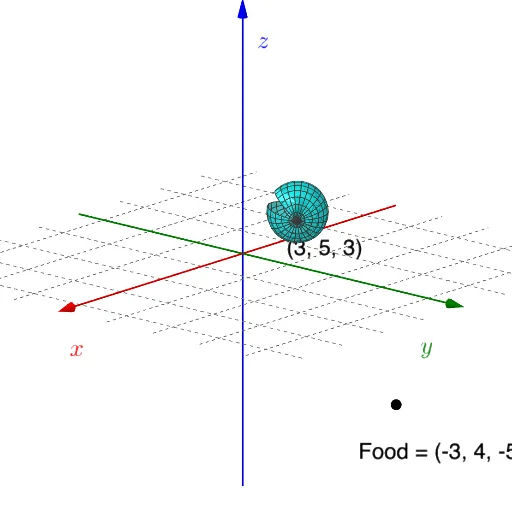
This example demonstrates guiding Pac-Man to food by determining vector components in a 3D space. Key math concepts include vectors, 3D coordinates, vector decomposition and composition, real numbers and fractions, angle calculations. It leverages GeoGebra commands like Random, Sequence, Union, Vector, RandomElement, CurveCartesian, Translate, Rotate, Line, Surface, and Dilate. Suitable for high school and university-level mathematics education focusing on 3D vectors and spatial geometry.
GeoGebra Commands & Parameters
Random(-5, 5) → aSequence(i, i, a + 1, 5, 1) → l3Sequence(i, i, -5, a - 1, 1) → l2Union(l2, l3) → l4Vector((xc, yc, zc)) → uRandom(-5, 5) → cRandomElement(l4) → bCurveCartesian(x(A) - sin(t), y(A) + cos(t), z(A), t, 0, π) → gTranslate(A, u) → A'Vector(A, A') → vRotate(A - (0, 1.5, 0), If[yc ≥ 0, α, (2 * π) - α], A, Line[A, A + (0, 0, 1)]) → DRotate(A + (0, 1.5, 0), If[yc ≥ 0, α, (2 * π) - α], A, Line[A, A + (0, 0, 1)]) → CRotate(g, If[yc ≥ 0, α, (2 * π) - α], A, Line[A, A + (0, 0, 1)]) → g'Rotate(g', If[zc ≥ 0, β, (2 * π) - β], A, If[zc ≥ 0, Line[C, D], Line[D, C]]) → g''Random(-5, 5) → dRandom(-5, 5) → eRandom(-5, 5) → fLine(C, D) → jSurface(g'', (3 * π / 4) + m, Line[C, D]) → kDilate(A, If[0 < l ≤ 1, 1 - l, 0], A') → A'_1Surface(g'', (3 * π / 4) + m, Line[D, C]) → iVector(A, A'_1) → wTranslate(i, w) → i'Translate(k, w) → k'Sequence(i, i, -5, 5, 1) → l1
AI Drawing Prompt Reference
Draw a 3D scene of Pac-Man eating food. Start by creating a random point as Pac-Man's initial position, then create a random direction vector to move Pac-Man along, rotate Pac-Man to face the food. Next, create a random plane to project Pac-Man's path onto, forming a ring-shaped path. Finally, create a 3D ring structure around this path to simulate Pac-Man eating the food.
The prompt above was compiled from the original drawing commands and is for reference only.