
Orthocenter Investigation: Triangle Types and Orthocenter Position
Loading the math board and drawing, please wait…
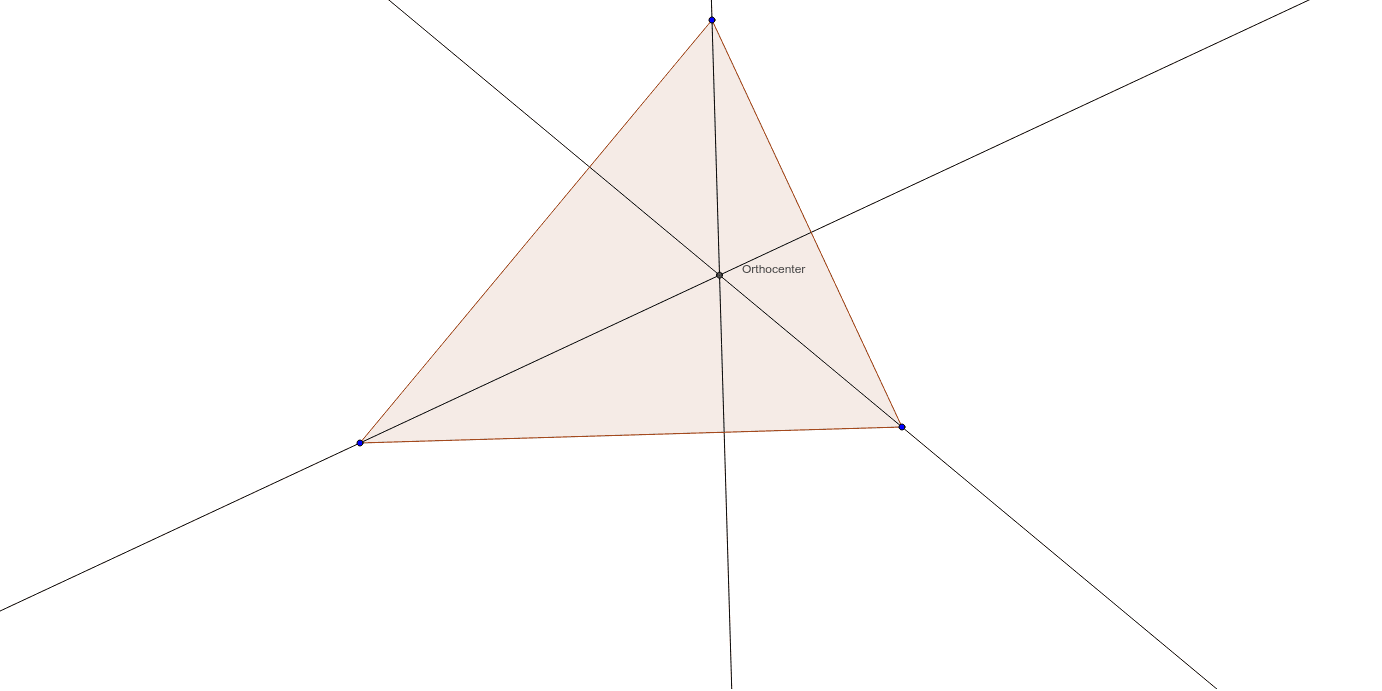
This GeoGebra example dynamically demonstrates how the orthocenter (the intersection of the three altitudes) of a triangle changes its position as the triangle's shape varies. The core mathematical concepts include the orthocenter, altitudes, and the classification of triangles by angles (acute, right, obtuse). The construction uses the Polygon command to create triangle ABC, the OrthogonalLine command to draw perpendiculars from each vertex to the opposite side, and the Intersect command to find the orthocenter as the common intersection of these three altitudes. By dragging the vertices, learners can observe that the orthocenter lies inside the triangle for acute triangles, at the right-angle vertex for right triangles, and outside for obtuse triangles. This resource is ideal for middle or high school geometry classes, helping students grasp the properties of the orthocenter and explore triangle centers through interactive manipulation.
GeoGebra Commands & Parameters
Polygon(A, B, C) → poly1, c, a, bOrthogonalLine(B, b) → dOrthogonalLine(A, a) → eOrthogonalLine(C, c) → fIntersect(d, e) → Orthocenter
AI Drawing Prompt Reference
Draw a triangle and show three perpendicular lines from each vertex to the opposite side, called altitudes. Find the intersection point of these three altitudes, known as the orthocenter. By dragging the vertices of the triangle, demonstrate that the orthocenter lies inside the triangle for acute angles, at the right-angle vertex for right angles, and outside the triangle for obtuse angles.
The prompt above was compiled from the original drawing commands and is for reference only.