
Orthocenter Exploration: Dynamic Geometry Introduction
Loading the math board and drawing, please wait…
In collections
Congruence (CO) Cluster
Congruence (Vol 2)
CCSS High School: Geometry (Congruence) Volume 2
CCSS High School: Geometry (Congruence) Volume 2
CCSS High School: Geometry (Congruence) Volume 2
Geometry (Congruence) Volume 2
CCSS High School: Geometry (Congruence) Volume 2
CCSS High School: Geometry (Congruence) Volume 2
CCSS High School: Geometry (Congruence) Volume 2
CCSS High School: Geometry (Congruence) Volume 2
CCSS High School: Geometry (Congruence) Volume 2
CCSS High School: Geometry (Congruence) Volume 2
Gail LeBlancCCSS High School: Geometry (Congruence) Volume 2
CCSS High School: Geometry (Congruence) Volume 2
CCSS High School: Geometry (Congruence) Volume 2
Triangle Theorems
Triangles: Points of Concurrency
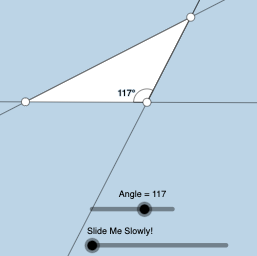
① This example demonstrates the concurrency of the three altitudes of a triangle at the orthocenter, and shows how the orthocenter's position changes as the triangle's vertices move. ② Core mathematical concepts include the definition of the orthocenter, altitude lines, perpendicularity, and the distinct locations of the orthocenter in acute, right, and obtuse triangles. ③ Construction highlights: from the construction summary, commands such as Rotate, Ray, Point, Polygon, Line, Segment, OrthogonalLine, Intersect, Dilate, and Angle are used to create triangle vertices A, B, C, construct altitudes via orthogonal lines, and determine the orthocenter D as their intersection, along with auxiliary circles, lines, and angle markers. ④ Suitable for middle or high school geometry lessons or student self-exploration, helping learners intuitively grasp the properties of the orthocenter and its relation to triangle shape, while also introducing dynamic geometry construction techniques.
GeoGebra Commands & Parameters
Rotate(A, ((-e) * pi / 180), B) → A'Ray(B, A') → qPoint(q) → CPolygon(A, B, C) → poly1, c, a, bLine(A, B) → fSegment(A, C) → gSegment(C, B) → hOrthogonalLine(C, f) → iIntersect(f, i) → DDilate(C, If[0 < d ≤ 1, 1 - d, 0], D) → C'Segment(C, C') → jSegment(C, D) → kAngle(C, C', A) → αLine(A, C) → lLine(B, C) → mOrthogonalLine(B, l) → nIntersect(l, n) → EDilate(B, If[1.5 < d ≤ 2.5, 2.5 - d, 0], E) → B'Segment(B, B') → pAngle(B, E, C) → βOrthogonalLine(A, m) → rIntersect(m, r) → FDilate(A, If[3 < d ≤ 4, 4 - d, 0], F) → A'_{1}Segment(A, A'_{1}) → sAngle(B, F, A) → γLine(C, D) → tLine(E, B) → f_1Line(A, F) → g_1Intersect(t, f_1) → GDilate(D, If[5 < d ≤ 6, 6 - d, 0], G) → D'Dilate(E, If[5 < d ≤ 6, 6 - d, 0], G) → E'Dilate(F, If[5 < d ≤ 6, 6 - d, 0], G) → F'Segment(F, F') → h_1Segment(E, E') → i_1Segment(D, D') → j_1Angle(C, B, A) → δ