
Origami Skeletal Octahedron Eversion
Loading the math board and drawing, please wait…
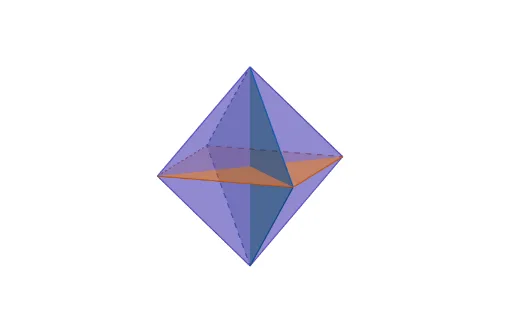
This example demonstrates the dynamic process of eversion (inversion) of an octahedron's skeletal structure through origami techniques. It involves core mathematical concepts such as polygon construction, geometric transformations, solid geometry, and spatial visualization. Key GeoGebra commands and objects used in the construction include Point, Intersect, Line, Polygon, Dilate, Plane, and Mirror, as outlined in the construction summary. It is suitable for high school students and math enthusiasts studying spatial geometric transformations and dynamic geometry demonstrations.
GeoGebra Commands & Parameters
Point(zAxis) → APoint(yAxis) → BPoint(xAxis) → CPoint(yAxis) → DPoint(xAxis) → EPoint(zAxis) → FIntersect(zAxis, xOyPlane) → OLine(O, Z) → aPolygon(B, C, D, E) → poly1, b, c, d, ePolygon(B, F, D, A) → poly2, b_1, f, d_1, a_1Polygon(E, F, C, A) → poly3, e_1, f_1, c_1, a_2Dilate(A, scalefactor, O) → A'Dilate(B, scalefactor, O) → B'Dilate(C, scalefactor, O) → C'Dilate(D, scalefactor, O) → D'Dilate(E, scalefactor, O) → E'Dilate(F, scalefactor, O) → F'Plane(F', C', D') → gMirror(O, g) → O'Polygon(C', O', F') → poly4, f', c', o'Polygon(C', D', O') → poly5, o'_1, c'_1, d'Polygon(F', O', D') → poly6, d'_1, f'_1, o'_2Mirror(poly4, poly3) → poly4'Mirror(poly6, poly2) → poly6'Mirror(poly5, poly1) → poly5'Mirror(poly4', poly2) → poly4''Mirror(poly4, poly2) → poly4'_1Mirror(poly4', poly1) → poly4''_1Mirror(poly4, poly1) → poly4'_2Mirror(poly4'_1, poly1) → poly7Mirror(poly4'', poly1) → poly4'''Mirror(poly6', poly3) → poly6''Mirror(poly6, poly3) → poly6'_1Mirror(poly6'_1, poly1) → poly8Mirror(poly6'', poly1) → poly6'''Mirror(poly6', poly1) → poly6''_1Mirror(poly6, poly1) → poly6'_2Mirror(poly5, poly3) → poly5'_1Mirror(poly5', poly3) → poly5''Mirror(poly5'_1, poly2) → poly9Mirror(poly5'', poly2) → poly5'''Mirror(poly5, poly2) → poly5'_2Mirror(poly5', poly2) → poly5''_1
AI Drawing Prompt Reference
Draw the skeletal structure of an octahedron and demonstrate its inversion through origami techniques. Start by creating points A, B, C, D, E, and F on the coordinate axes, then construct point O on the xOy plane and line a through point O and the coordinate axes. Construct quadrilaterals BCEF, BCDE, and ECFA, then perform a scaling transformation around point O to generate new points A', B', C', D', E', and F'. Next, construct plane g and use a series of mirror transformations to generate new quadrilaterals, and finally, use more mirror transformations to complete the final shape.
The prompt above was compiled from the original drawing commands and is for reference only.