
Orbital Dance of Terrestrial Planets (Heliocentric and Geocentric Models)
Loading the math board and drawing, please wait…
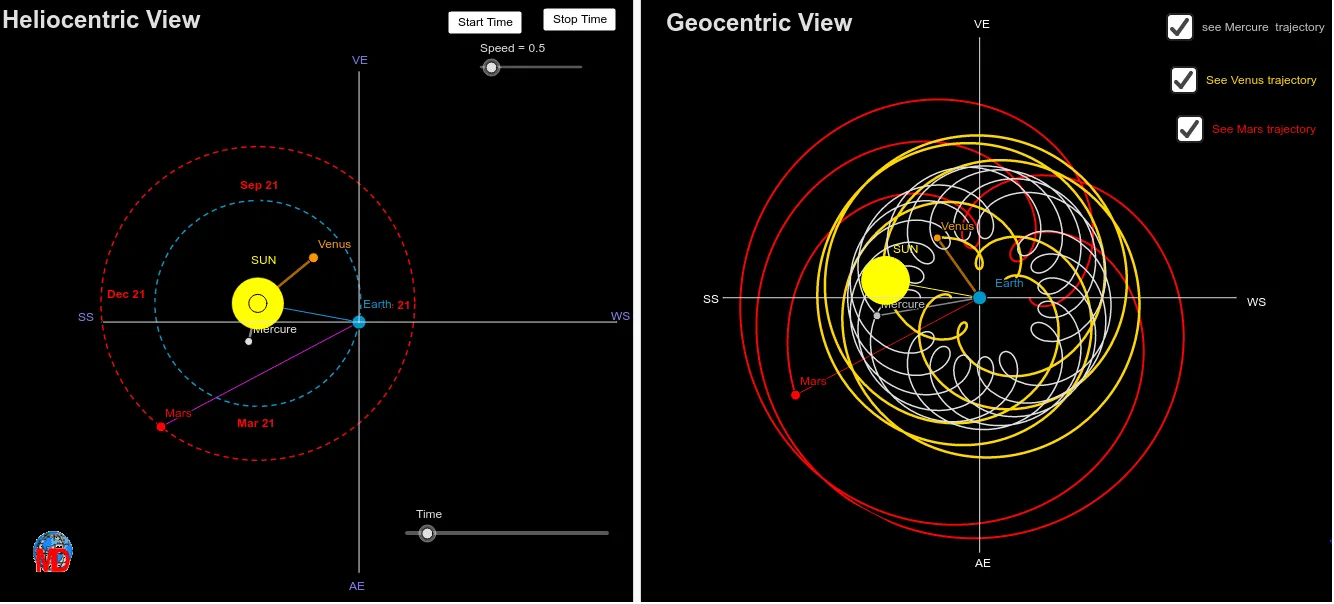
This example demonstrates the orbital paths of inner planets (Mercury, Venus, Earth, Mars) under both heliocentric and geocentric models. Key mathematical concepts include parametric curves, coordinate geometry, similarity transformations, circles, fractions, and hyperbolas. Construction highlights the use of GeoGebra commands like Point, Segment, OrthogonalLine, Intersect, Circle, Mirror, Mod, If, CurveCartesian, and Polygon, as detailed in the construction summary. Suitable for high school and advanced learners studying celestial mechanics, coordinate transformations, and higher mathematics applications.
GeoGebra Commands & Parameters
Point(xAxis) → OPoint(yAxis) → LSegment(E_2, L) → nPoint(n) → SOrthogonalLine(Earth, yAxis) → gPoint(g) → FIntersect(xAxis, yAxis) → ACircle(A, r_E) → cCircle(A, r_M) → dSegment(Mars, Earth) → aSegment(E_2, M_2) → bPoint(yAxis) → BSegment(E_2, S_2) → eOrthogonalLine(Earth, xAxis) → fPoint(f) → DMirror(D, Earth) → GIntersect(c, yAxis, 2) → HIntersect(c, xAxis, 1) → IIntersect(c, yAxis, 1) → JIntersect(c, xAxis, 2) → KPoint(yAxis) → NPoint(g) → QMod((Angle[Q, Earth, A] - 90°) / (15°), 24) → RA_{Sun}Mod(Angle[B, E_2, M_2] / (15°), 24) → RA_{Mars}If(RA_+ > RA_{Mars}, "Prograde", "Retrograde") → RetCurveCartesian((r_M * cos(((2 * π) * (Time - i) / T_M))) - (r_E * cos(((2 * π) * (Time - i) / T_E))), (r_M * sin(((2 * π) * (Time - i) / T_M))) - (r_E * sin(((2 * π) * (Time - i) / T_E))), i, 0, Time) → hCircle(A, 0.5) → kCircle(S_2, 0.5) → pMirror(F, Earth) → CSegment(Earth, C) → iPoint(i) → RSegment(R, D) → jSegment(R, G) → lSegment(R, F) → mSegment(S, O) → rSegment(S, N) → sMirror(O, S) → PSegment(S, P) → a_1Segment(A, Earth) → b_1Polygon(T, U, V, W, Z, A_1, B_1) → poly1, t_1, u, v, w, z, a_2, b_2Polygon(C_1, D_1, E_1, F_1) → poly2, c_1, d_1, e_1, f_1Polygon(G_1, H_1, I_1, J_1) → poly3, g_1, h_1, i_1, j_1CurveCartesian((rv * cos(((2 * π) * (Time - i) / Tv))) - (r_E * cos(((2 * π) * (Time - i) / T_E))), (rv * sin(((2 * π) * (Time - i) / Tv))) - (r_E * sin(((2 * π) * (Time - i) / T_E))), i, 0, Time) → l_1Segment(E, E_2) → k_1CurveCartesian((rmer * cos(((2 * π) * (Time - i) / Tmer))) - (r_E * cos(((2 * π) * (Time - i) / T_E))), (rmer * sin(((2 * π) * (Time - i) / Tmer))) - (r_E * sin(((2 * π) * (Time - i) / T_E))), i, 0, Time) → m_1Segment(E_2, M) → n_1Segment(Mercure, A) → p_1Segment(A, Venus) → q_1
AI Drawing Prompt Reference
Draw a diagram showing the orbital motion of inner planets (Mercury, Venus, Earth, Mars) under both heliocentric and geocentric models. Place the Sun at the origin of coordinate axes, with circular orbits for each planet. Mark current positions of planets on their orbits. Draw radial segments from the Sun to each planet. Construct perpendicular lines through Earth and related auxiliary points and segments to illustrate geometric transformations. Use parametric curves to trace the relative paths of planets with respect to Earth, creating intricate patterns. Include markers for time or angles, and distinguish prograde versus retrograde motion. The composition includes several polygonal regions for annotation or decoration, emphasizing the geometric relationships in celestial motion.
The prompt above was compiled from the original drawing commands and is for reference only.