
Optimal Gum Purchase
Loading the math board and drawing, please wait…
In collections
PARCC Math II Unit 6 Lesson 1
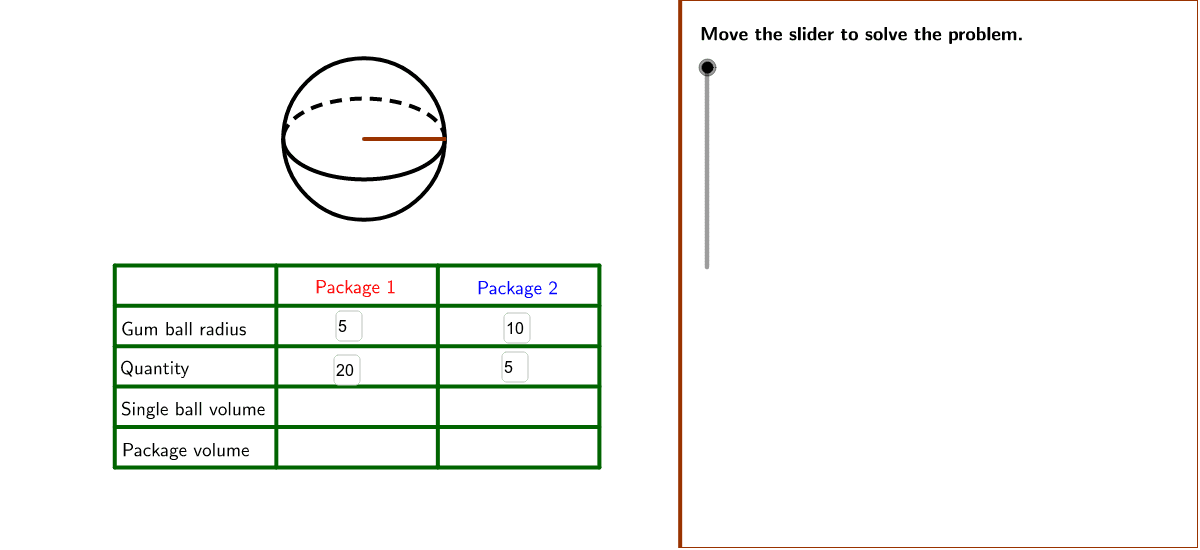
This example demonstrates how to choose the gum package that offers the most volume under a fixed budget by comparing different packages. Key math concepts include volume calculation, inequality comparison, and optimization. GeoGebra commands and objects used are Polygon, CurveCartesian, Segment, Textfield, Circle, Sequence, and If. Suitable for high school students learning solid geometry and optimization problems.
GeoGebra Commands & Parameters
Polygon((Edge, y(Corner[1])), Corner[2], Corner[3], (Edge, y(Corner[4]))) → Mask, a, b, c, dCurveCartesian(x(A) + cos(theta), y(A) + (0.5 * sin(theta)), theta, 3.141592653589793, 6.28319) → Curve1CurveCartesian(x(A) + cos(theta), y(A) + (0.5 * sin(theta)), theta, 0, 3.141592653589793) → Curve2Segment(A, A + (1, 0)) → RadTextfield(Radius1) → Radius1boxTextfield(Radius2) → Radius2boxTextfield(Quantity1) → Quantity1boxTextfield(Quantity2) → Quantity2boxCircle(A, 1) → eSequence(Segment[((2 * i), (-2)), ((2 * i), 0.5)], i, -1, 2) → vSegsSequence(Segment[((-2), i / 2), (4, i / 2)], i, -4, 1) → hSegsIf(TVolume1 > TVolume2, 1, 2) → BigPack
AI Drawing Prompt Reference
Draw a diagram showing how to choose the gum package with the most volume under a fixed budget. Include a quadrilateral formed by four line segments, a circle centered at one of its vertices with a radius of 1, and two rays starting from the center at 30° and 60° angles to the x-axis. Use dashed lines to draw two horizontal and four vertical lines creating a grid. Label the radii and quantities of the two circles above the diagram, and differentiate the two packages below with different colors, indicating which has a larger volume.
The prompt above was compiled from the original drawing commands and is for reference only.