
Opposite Side Length of Hexagon
Loading the math board and drawing, please wait…
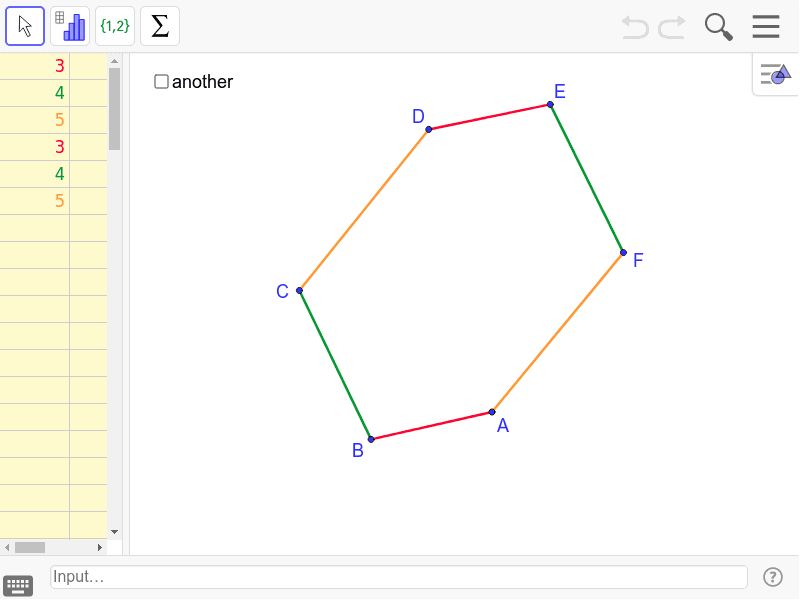
This example demonstrates the relationship between the lengths of opposite sides in a regular hexagon. Key mathematical concepts include polygons, angles, and geometric construction. Using GeoGebra commands such as Point, Segment, Circle, and Intersect, one can construct a regular hexagon and observe the lengths of its opposite sides. Suitable for middle school and above students or math enthusiasts.
GeoGebra Commands & Parameters
Point(Circle[A, A1]) → BSegment(A, B) → aPoint(Circle[B, A2]) → CSegment(B, C) → bPoint(Circle[C, A3]) → DSegment(C, D) → cPoint(Circle[D, A4]) → ESegment(D, E) → dCircle(E, A5) → eCircle(A, A6) → fIntersect(e, f) → F, G, ,Segment(E, F) → gSegment(F, A) → hSegment(E, G) → iSegment(A, G) → j
AI Drawing Prompt Reference
Draw a regular hexagon and mark one pair of opposite sides. Start by taking point A on a circle, then connect points A, B, C, D, and E to form five sides of the hexagon. Next, take point F on the circle, connect points E and F, then connect points F and A, and finally connect points E and F, and F and A to complete the hexagon.
The prompt above was compiled from the original drawing commands and is for reference only.