
Opposite Angles of Hexagon
Loading the math board and drawing, please wait…
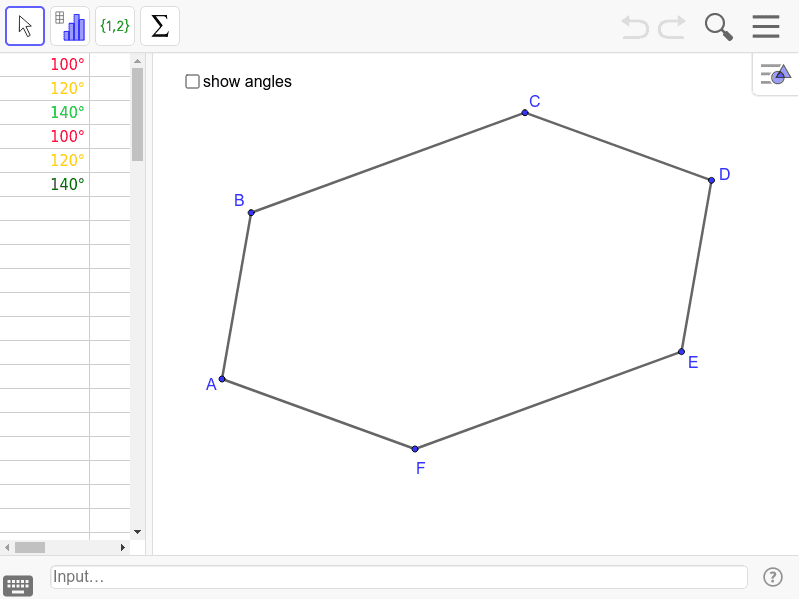
This example demonstrates the relationship between opposite angles in a hexagon, involving core math concepts like polygons, angles, and geometric transformations. It is constructed using GeoGebra commands such as Segment, Rotate, Angle, Ray, Point, Line, and Intersect, making it suitable for high school geometry education or exploration by enthusiasts.
GeoGebra Commands & Parameters
Segment(F, A) → aRotate(F, A1, A) → A'Angle(F, A, A') → αRay(A, A') → bPoint(b) → BRotate(A, A2, B) → B'Angle(A, B, B') → βRay(B, B') → cPoint(c) → CRotate(B, A3, C) → C'Angle(B, C, C') → γRay(C, C') → dPoint(d) → DRotate(C, A4, D) → D'Angle(C, D, D') → δRay(D, D') → ePoint(e) → F_1Rotate(D, A5, F_1) → E'Angle(D, F_1, E') → εRay(F_1, E') → fRay(A, F) → gSegment(A, B) → hSegment(B, C) → iSegment(C, D) → jLine(F, f) → kIntersect(k, e) → ESegment(D, E) → lSegment(E, F) → mAngle(D, E, F) → ζAngle(E, F, A) → η
AI Drawing Prompt Reference
Draw a hexagon by connecting adjacent vertices to form six sides. Then rotate each vertex to generate new vertices and angles, ultimately forming six diagonals and six interior angles.
The prompt above was compiled from the original drawing commands and is for reference only.