
Open Middle Problem: Complementary and Supplementary Angles
Loading the math board and drawing, please wait…
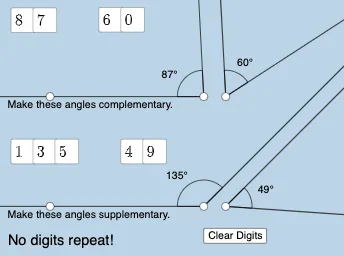
① This GeoGebra example demonstrates the concepts of complementary angles (sum to 90°) and supplementary angles (sum to 180°) through an interactive open-middle problem. ② Core mathematical concepts include angle measurement, complementary and supplementary relationships, rotation of rays, and conditional verification of angle sums. ③ Construction highlights: from the summary, the example uses commands such as Textfield, Line, Rotate, Ray, Angle, Mode, If, and Point, with multiple objects (a, b, c, d, etc.) and rotated points (A', A'', C', C'') to create dynamic angles α, β, γ, δ for exploring various angle pairs. ④ Suitable for middle school geometry lessons or exploratory activities, helping students grasp angle relationships and practice problem-solving by adjusting inputs to find valid combinations.
GeoGebra Commands & Parameters
Textfield(a) → a1Textfield(b) → a2Textfield(c) → a3Textfield(d) → a4Textfield(e) → a5Textfield(f) → a6Textfield(g) → a7Textfield(h) → a8Textfield(i) → a9Line(A, B) → lRotate(A, ((-j) * π / 180), B) → A'Ray(B, A') → mAngle(A', B, A) → αRay(B, A) → nRotate(A', ((-k) * π / 180), B) → A''Ray(B, A'') → pAngle(A'', B, A') → βRotate(C, ((-o) * π / 180), D) → C'Ray(D, C) → qRay(D, C') → rRotate(C', ((-((10 * h) + i)) * π / 180), D) → C''Ray(D, C'') → sAngle(C', D, C) → γAngle(C', D, C'') → δMode(l1) → l2If(Length[l2] ≟ 0, "No digits repeat!", "Repeated digits exist.") → text1Line(E, m) → tPoint(t) → FRotate(F, (-β), E) → F'Ray(E, F') → f_1Angle(F, E, F') → εRay(E, F) → g_1Line(G, r) → h_1Line(G, s) → i_1Point(h_1) → HRotate(H, ((-((10 * h) + i)) * π / 180), G) → H'Angle(H', G, H) → ζRay(G, H') → j_1Ray(G, H) → k_1
AI Drawing Prompt Reference
Create a dynamic geometric diagram showing complementary and supplementary angles. Include two pairs of rays forming angles α and β, and two other pairs forming angles γ and δ. Adjust angles with sliders to verify that α and β sum to 90°, and γ and δ are supplementary. The diagram should feature multiple points, lines, rays, and text to display angle measures and conditional checks, suitable for exploring angle relationships.
The prompt above was compiled from the original drawing commands and is for reference only.