
Octahedron and Boat
Loading the math board and drawing, please wait…
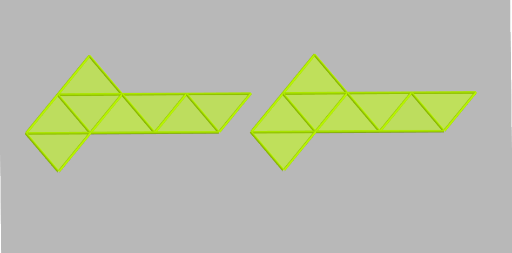
This example demonstrates how to construct two different solids from the same net. It involves core mathematical concepts such as solid geometry, polygons, angles, and geometric transformations. Key GeoGebra commands and objects used in the construction include Octahedron, OrthogonalPlane, Intersect, Mirror, Angle, Rotate, Circle, Center, OrthogonalLine, Translate, Tetrahedron, and Polygon. It is suitable for high school students learning solid geometry and geometric construction, helping to develop spatial reasoning skills and understanding the relationship between nets and 3D shapes.
GeoGebra Commands & Parameters
Octahedron(A, B, xOyPlane) → a, C, faceBCE, faceCEF, faceDEF, edgeAC, edgeAB, edgeBC, edgeAF, edgeCF, edgeAD, edgeDF, D, edgeBD, edgeBE, edgeDE, edgeCE, edgeEF, E, F, faceABC, faceACF, faceADF, faceABD, faceBDEOrthogonalPlane(D, edgeAB) → bIntersect(edgeAB, b) → GMirror(C, G) → C'Angle(C', G, D) → αRotate(faceACF, (t * α), edgeAC) → faceACF'Circle(A, C, B) → cCenter(c) → HOrthogonalLine(H, xOyPlane) → dRotate(faceACF', (-(120°)), d) → faceACF''Rotate(F, (t * α), edgeAC) → F'Circle(F', A, C) → eCenter(e) → IOrthogonalLine(I, faceACF') → fRotate(faceABC, 120°, f) → faceABC'Rotate(faceABC, (-(120°)), f) → faceABC'_1Rotate(F', (-(120°)), d) → F''Circle(C, B, F'') → gCenter(g) → JOrthogonalLine(J, faceACF'') → hRotate(faceABC, 120°, h) → faceABC'_2Rotate(B, (-(120°)), f) → B'Circle(F', B', A) → kCenter(k) → KOrthogonalLine(K, faceABC'_1) → iRotate(faceACF', (-(120°)), i) → faceACF''_1Rotate(A, 120°, h) → A'Circle(B, F'', A') → pCenter(p) → LOrthogonalLine(L, faceABC'_2) → jRotate(faceACF'', (-(120°)), j) → faceACF'''Translate(B, Vector[A, M]) → B'_1Tetrahedron(M, B'_1, xOyPlane) → l, N, edgeMO, edgeNO, edge3, O, face1, faceMNO, face2, face3, edgeMN, edge1, edge2Tetrahedron(O, B'_1, face3) → m, P, edgeOQ, edgePQ, edge6, Q, face4, faceOPQ, face5, face6, edgeOP_1, edge4, edge5Tetrahedron(O, P, faceMNO) → n, R, edgeOS, edgeRS, edgePS, S, faceOPR, faceORS, faceOPS, facePRS, edgeOR, edgeOP, edgePROrthogonalPlane(Q, edge2) → oIntersect(edge2, b) → TIntersect(edge5, o) → UMirror(M, U) → M'Angle(M', U, Q) → βRotate(Q, (t * β), edge5) → Q'Polygon(N, B'_1, Q') → poly1, q', n_1, b'_1Rotate(O, (t * β), edge5) → O'Rotate(O', ((180° - α) * t), Segment[B'_1, Q']) → O''Polygon(B'_1, Q', O'') → poly2, o'', b'_2, q'_1Rotate(N, ((180° - α) * t), Segment[B'_1, Q']) → N'Rotate(N', ((180° - α) * t), Segment[O'', Q']) → N''Polygon(Q', O'', N'') → poly3, n'', q'_2, o''_1Rotate(S, (t * β), edgeMN) → S'Polygon(M, N, S') → poly4, s', m_1, n_2Rotate(O, (t * β), edgeMN) → O'_1Rotate(O'_1, ((180° - α) * t), Segment[N, S']) → VPolygon(S', N, V) → poly5, v, s'_1, n_3Rotate(O'_1, ((180° - α) * t), Segment[S', M]) → WPolygon(M, S', W) → poly6, w, m_2, s'_2Rotate(B'_1, (t * β), edgeMN) → ZRotate(Z, ((180° - α) * t), Segment[S', M]) → Z'Rotate(Z', (β * t), Segment[W, M]) → Z''Polygon(W, Z'', M) → poly7, m_3, w_1, z''Polygon(M, B'_1, N) → poly8, n_4, m_4, b'_3
AI Drawing Prompt Reference
Draw an octahedron and a boat shape, demonstrating how two different solids can be constructed from the same net. Start by creating the net of the octahedron, then use rotations and reflections to form the boat shape. Illustrate key geometric concepts like polygons, angles, and transformations to help understand the relationship between nets and 3D shapes.
The prompt above was compiled from the original drawing commands and is for reference only.