
Obvious Trapezoid Theorem? – Dynamic Illustration for All Trapezoids
Loading the math board and drawing, please wait…
In collections
Quadrilaterals
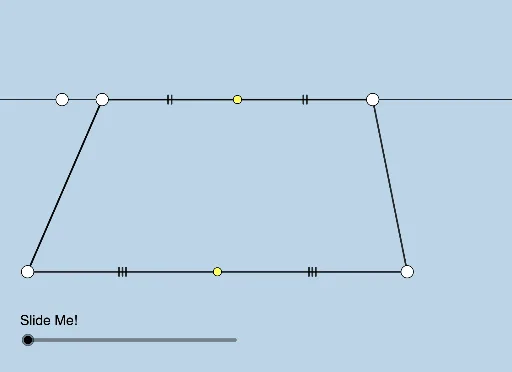
① This example provides a dynamic and modifiable illustration of a geometric phenomenon that holds true for every trapezoid, challenging the notion of 'obviousness' through visual exploration. ② Core mathematical concepts include special points of a trapezoid (midpoints, intersections), construction of equilateral triangles, and the resulting parabolic locus and segment relationships, highlighting invariance under dynamic changes. ③ Construction details: Based on the summary, GeoGebra commands such as Line, Point, Segment, Intersect, Midpoint, Polygon, Dilate, Vector, Translate, and Circle are used to create multiple points, lines, polygons, and auxiliary circles, with transformations like translation and dilation to generate dynamic objects, enabling interactive manipulation of the trapezoid. ④ Suitable for middle school to college geometry classes, this resource aids in exploring trapezoid properties, special point loci, and dynamic geometry invariants, serving as a teaching demonstration or student inquiry tool.
GeoGebra Commands & Parameters
Line(A, B) → fLine(C, f) → gPoint(g) → DLine(C, D) → sSegment(A, D) → lLine(B, l) → rIntersect(r, s) → ILine(A, D) → hPoint(Segment[D, I]) → FSegment(D, F) → jSegment(F, B) → kMidpoint(j) → GMidpoint(A, B) → HSegment(G, H) → mPolygon(H, G, D) → t1, d, h_1, g_1Segment(A, H) → nSegment(H, B) → pSegment(G, F) → qPolygon(D, H, A) → t2, a, d_1, h_2Dilate(G, If[0 < b ≤ 1, 1 - b, 0], F) → G'Vector(G, G') → uTranslate(H, u) → H'Translate(G, u) → G'_1Translate(D, u) → D'Polygon(H', G'_1, D') → t1', d', h', g'_1Circle(A, Distance[H, H']) → cLine(A, B) → iIntersect(c, i) → E, JDilate(D, If[1 < b ≤ 2, 2 - b, 0], J) → D'_1Segment(D, D'_1) → tVector(H', G) → vTranslate(J, v) → J'Vector(H', F) → wSegment(D', H') → eSegment(H', G') → f_1Segment(D, G) → i_1Segment(D', G') → j_1Polygon(J, H, D) → t3, d_2, j_2, h_3Polygon(D, A, J) → t4, j_3, d_3, a_1Segment(D, A) → k_1Segment(D, H) → l_1Dilate(D, If[2.5 ≤ b ≤ 3.5, 3.5 - b, 0], J') → D'_2Vector(D, D'_2) → u_1Segment(A, D'_2) → m_1Segment(D'_2, J) → n_1Polygon(A, J, D'_2) → t5, d'_2, a_2, j_4Dilate(J', If[3.5 < b ≤ 4.5, 4.5 - b, 0], G) → J'_2Vector(J', J'_2) → v_1Translate(A, v_1) → A'Translate(J, v_1) → J'_3Translate(D'_2, v_1) → KPolygon(A', J'_3, K) → t5', k_2, a', j'_3Translate(A, v_1) → A'_1Translate(D'_2, v_1) → LSegment(A'_1, L) → p_1Translate(D'_2, v_1) → MTranslate(J, v_1) → J'_4Segment(M, J'_4) → q_1Circle(J, Distance[H', F]) → c_1Intersect(c_1, s) → N, ODilate(D, If[5 < b ≤ 6, 6 - b, 0], If[k_1 ≥ k, O, N]) → D'_3Vector(D, D'_3) → w_1Polygon(J, H, D'_3) → t6, d'_3, j_5, h_4Segment(J, D'_3) → r_1Segment(H, D'_3) → s_1Dilate(J, If[6 < b ≤ 7, 7 - b, 0], H') → H'_1Vector(J, H'_1) → b_1Translate(J, b_1) → J'_1Translate(H, b_1) → H'_2Translate(D'_3, b_1) → PPolygon(J'_1, H'_2, P) → t6', p_2, j'_1, h'_2Segment(J'_1, P) → t_1Segment(P, H'_2) → e_1Segment(G, F) → f_2Dilate(G, If[-2 < b ≤ -1, -1 - b, 0], H) → G'_2Segment(G, G'_2) → g_2Dilate(D, If[-2 < b ≤ -1, -1 - b, 0], H) → D'_4Segment(D, D'_4) → i_2Polygon(A, H, D) → t7, d_4, a_3, h_5
AI Drawing Prompt Reference
Draw a dynamic and variable trapezoid, showing its special points (midpoints, intersections) and equilateral triangle construction. Demonstrate the relationship between isosceles triangles and parabolic loci through dynamic changes, and use translation and dilation to explore trapezoid properties, special point loci, and geometric invariants.
The prompt above was compiled from the original drawing commands and is for reference only.