
Oblique Pyramid Unfolding
Loading the math board and drawing, please wait…
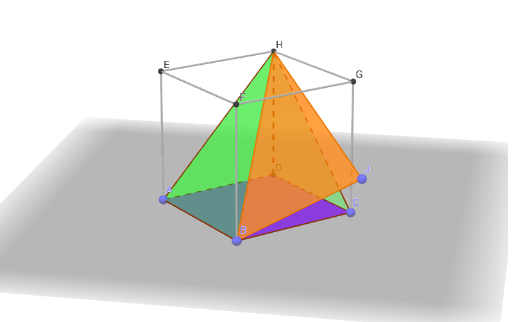
This example demonstrates the unfolding of an oblique pyramid. Key mathematical concepts include solid geometry and geometric construction. Using GeoGebra commands such as Point, Cube, Intersect, Pyramid, etc., various faces and edges of the oblique pyramid can be constructed. Suitable for high school or university solid geometry courses.
GeoGebra Commands & Parameters
Point(yAxis) → APoint(xAxis) → BPoint(Circle[B, Distance[A, B], Segment[A, B]]) → CCube(A, B, C) → a, D, faceCDHG, faceEFGH, edgeAD, edgeAB, edgeBC, edgeCD, edgeAE, edgeDH_1, edgeEH, edgeEF, E, edgeBF, edgeFG, edgeCG, edgeGH, F, G, H, faceABCD, faceADHE, faceABFE, faceBCGFIntersect(edgeEH, edgeDH_1) → IPyramid(faceABCD, H) → b, faceADH, faceABH, faceBCH, faceCDH, edgeDH, edgeAH, edgeBH, edgeCHCircle(edgeBH, C) → cPoint(c) → JPolygon(J, B, H) → poly1, h, j, b_1
AI Drawing Prompt Reference
Draw an oblique pyramid unfolding, including the base ABCD, vertex H, and the connecting edges, as well as the unfolded side faces. Start by defining points A, B, and C on the coordinate axes, then construct a cube, find the intersection point I of edge EH and edge DH1, construct the oblique pyramid with vertex H, and finally connect vertex H to each point on the base to form the unfolding.
The prompt above was compiled from the original drawing commands and is for reference only.