
Number Patterns and Sequences Self Assessment Practice
Loading the math board and drawing, please wait…
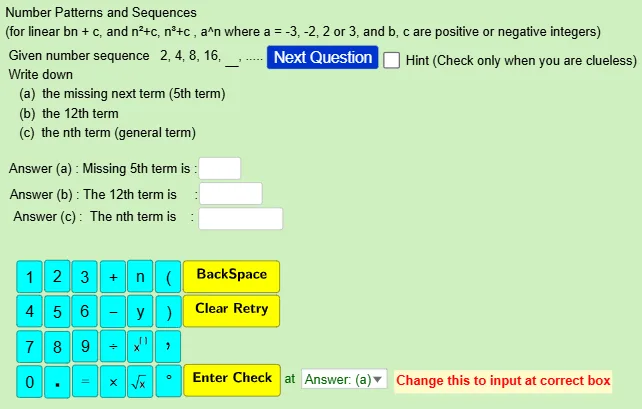
This example demonstrates how to construct and analyze general term number sequences involving linear, 'shifted' squares, and cubes using GeoGebra. Core math concepts include sequence general term formulas, linear functions, quadratic functions, cubic functions, and coordinate geometry. Construction highlights include commands like If, RandomElement, Sequence, Element, Textfield, Expand, TextToUnicode, IndexOf, First, LaTeX, and objects such as counter, k, d, c, b, a, e, listSequence1, textTitle, textSequence1, button1, answera, answerb, inputa, inputb, inputc, InputBox1, InputBox2, InputBox3, usera, answerc, userb, text1, userc, answerccorrect, answeracorrect, answerbcorrect, I_{a1}, I_{a2}, picacorrect, picawrong, piccwrong, picbwrong, I_{c1}, I_{c2}, picccorrect, I_{b1}, I_{b2}, picbcorrect, trieda. Suitable for high school students learning sequences, function graphing, and self-assessment practice.
GeoGebra Commands & Parameters
If(counter < 11, 0, RandomElement[{-1, -2, 1, 2, 3, 1, 1, 1}]) → kIf(counter > 8, If[counter > 10, 0, 1], 0) → dIf(counter < 2, 0, If[counter < 5, RandomElement[{0, -3, -2, -1, 0, 1, 2, 3, 0}], If[counter < 11, RandomElement[{-2, -1, 0, 1, 2}], 0]]) → cIf(counter < 7, RandomElement[{-3, -2, -1, 1, 2, 3, 4, 5}], 0) → bIf(counter < 7, 0, If[counter < 9, 1, 0]) → aRandomElement({-3, -2, 2, 3}) → eSequence((k * e^(n - 1)) + (d * n^(3)) + (a * n^(2)) + (b * n) + c, n, 1, 20) → listSequence1, {2, 4, 8, 16, 32, 64, 128, 256, 512, 1024, 2048, 4096, 8192, 16384, 32768, 65536, 131072, 262144, 524288, 1048576}Element(listSequence1, 5) → answeraElement(listSequence1, 12) → answerbTextfield(inputa) → InputBox1Textfield(inputb) → InputBox2Textfield(inputc) → InputBox3Expand(Simplify[If[1 ≤ n ≤ 200, (k * e^(n - 1)) + (d * n^(3)) + (a * n^(2)) + (b * n) + c]]) → answercTextToUnicode(LaTeX[answerc]) → listFunctionwithIntervalUnicodeIndexOf(44, listFunctionwithIntervalUnicode) → commapositionFirst(listFunctionwithIntervalUnicode, commaposition - 1) → listFunctionOnlyUnicodeLaTeX(UnicodeToText[listFunctionOnlyUnicode]) → textFunctionOnly
AI Drawing Prompt Reference
Create a graph showing a sequence involving linear, quadratic, and cubic functions, with the general term formula displayed. Highlight the first 20 terms of the sequence in different colors, marking key values. Include text boxes for inputting and verifying the general term formula.
The prompt above was compiled from the original drawing commands and is for reference only.