
Newton's Bucket
Loading the math board and drawing, please wait…
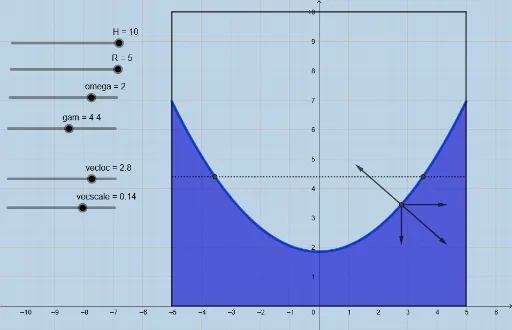
This example demonstrates Newton's Bucket, illustrating the physical phenomenon and mathematical model of rotational dynamics and centrifugal force through dynamic visualization. Core mathematical concepts include vectors, integrals, derivatives, and trigonometric functions. Construction highlights the use of GeoGebra commands such as Segment, Intersect, Vector, Tangent, OrthogonalVector, IntegralBetween, and If. Suitable for high school students and math enthusiasts studying the integration of calculus and physics.
GeoGebra Commands & Parameters
Segment(((-R), gam), (R, gam)) → jIntersect(c, j) → A, BVector((vecloc, c(vecloc)), (vecloc, c(vecloc) - (9.8 * vecscale))) → uVector((vecloc, c(vecloc)), (vecloc + ((vecscale * vecloc) * omega^(2)), c(vecloc))) → vTangent(vecloc, c) → kOrthogonalVector(k) → aVector(E, E + w) → dVector(E, E - w) → eSegment(((-R), 0), ((-R), H)) → fSegment(((-R), H), (R, H)) → hSegment((R, H), (R, 0)) → iSegment((R, 0), ((-R), 0)) → lIntegralBetween(q, 0, (-R), R) → mIf(gam < H / 2, (2 / R * sqrt((9.8 * gam))), (2 / R * sqrt((9.8 * (H - gam))))) → omegamax
AI Drawing Prompt Reference
Draw a rotating bucket of water to illustrate the centrifugal force effect. At the bottom center of the bucket, connect a horizontal line to the edge of the bucket, with intersection points where forces of gravity and centrifugal force act, represented as vectors pointing downward and outward respectively. Include horizontal and vertical line segments to form the bucket's shape. Above the horizontal line, place an integral symbol to denote the calculation of centrifugal force. When the rotation angle is less than half the bucket's height, the centrifugal force magnitude scales with the square root of the rotation angle.
The prompt above was compiled from the original drawing commands and is for reference only.